How to set goals for 2027 that you will actually keep
Most New Year goals fade by February, not because people lack willpower, but because the goals were never built to last. Here is a practical way to choose three goals for 2027, write them so they are clear, and keep them alive all year with a simple review rhythm.
Every January, millions of people write the same goals: get fit, save more, read more, learn something new. By February, most of those goals are gone.
The problem is rarely willpower. It is that the goals were chosen in a rush, written as wishes, and never looked at again. A goal that lives only in your head on January 1 has to compete with every urgent thing that happens in the next eleven months.
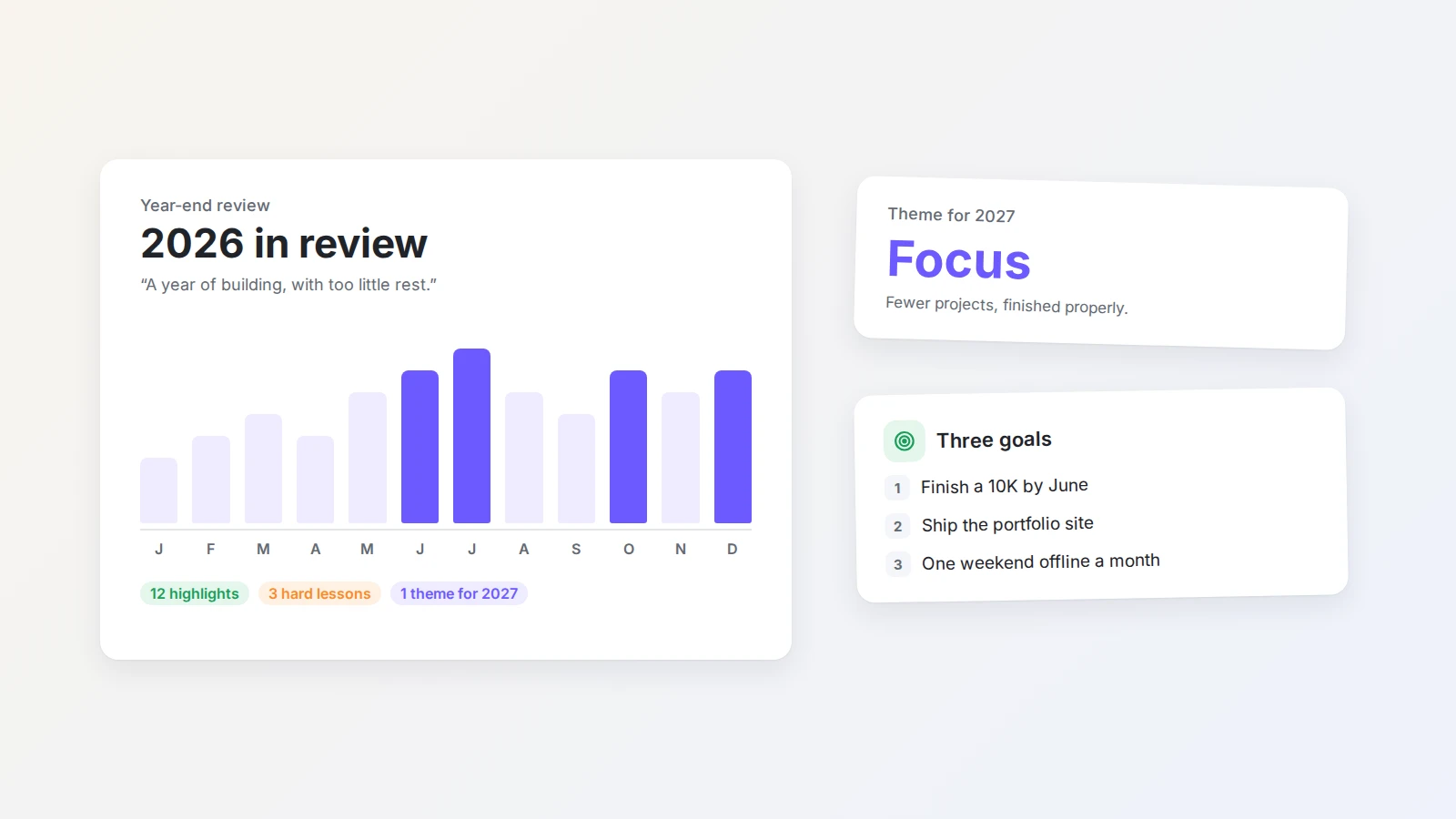
This guide shows a practical way to set goals for 2027: start from a long list, choose a few, write each one clearly, and give them a review rhythm that keeps them alive. If you have not looked back at 2026 yet, start with our year-end review guide and come back here for the planning part.
The short answer
To set goals for 2027 that you will keep, first review 2026, then write a long list of everything you might want next year. Choose no more than three goals and decide what type each one is: an outcome, a habit, or a project. Write each goal on a one-page card with the finish line, the reason, and the first step, and put that first step in your calendar before January. Then review the goals briefly every month and properly every quarter.
Why most New Year goals fail
Before choosing goals, it helps to know how they usually break:
- Too many at once. Ten goals compete for the same evenings and weekends. Usually none of them gets enough attention.
- Written as wishes. "Be healthier" has no finish line, so there is never a moment to start and never a moment to feel done.
- No first step. A big goal without a small next action stays in the "later" pile.
- Never reviewed. Without a check-in, a goal disappears the first busy week and nobody notices.
- Copied from other people. Goals that do not fit your life feel like obligations and are the first to go.
Each step below fixes one of these problems.
Step 1: Look back before you look forward
The best 2027 goals come from what 2026 taught you. Spend an hour with your calendar, notes, and photos and answer three questions:
- What went well, and what made it work?
- What drained energy or took more time than it was worth?
- What did I keep postponing, and do I still want it?
The answers point to goals that matter to you, not goals you think you should have. For a fuller reflection, go through the year month by month and write down one highlight and one low point for each.
Step 2: Write a long list, then choose three
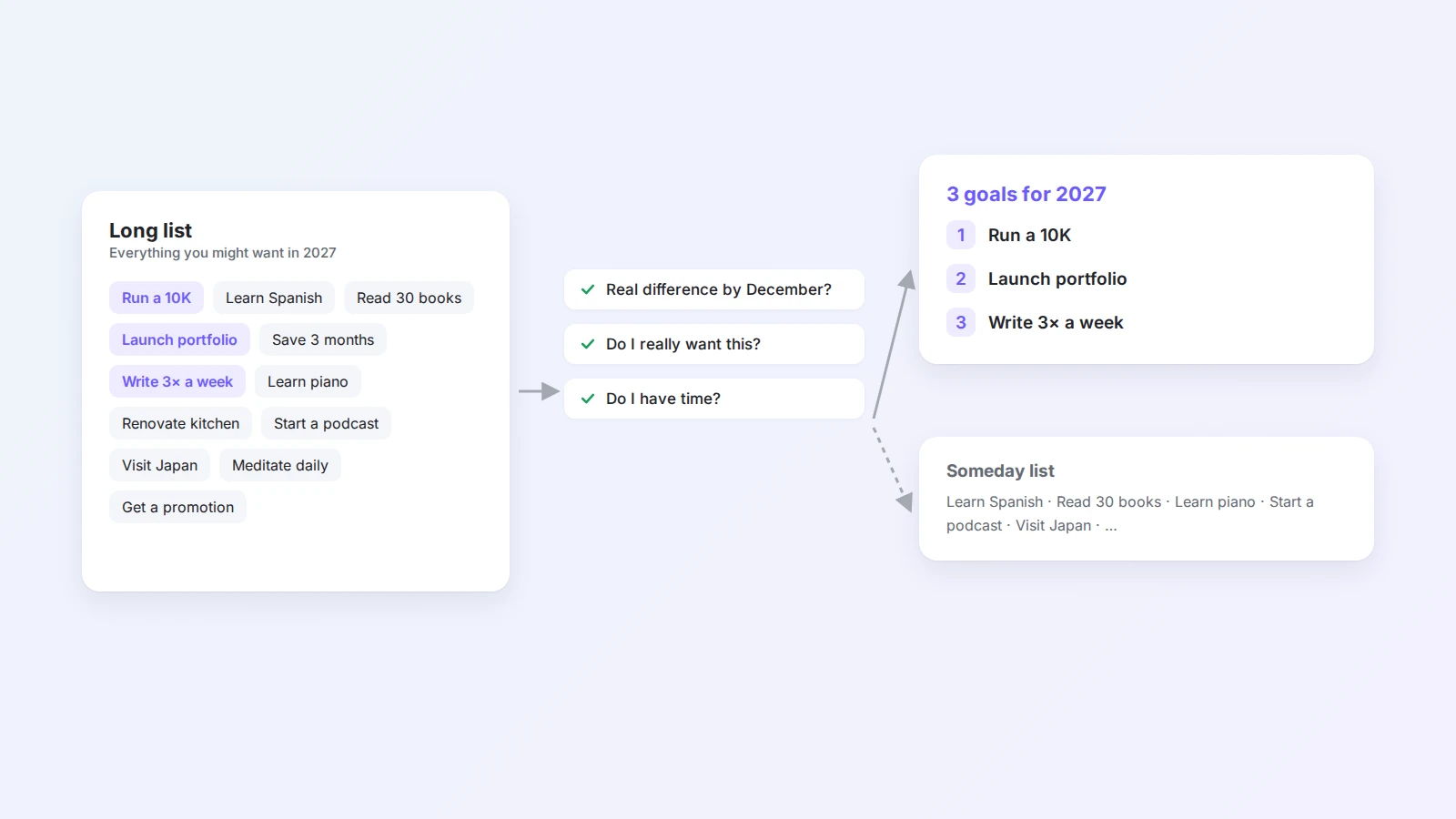
Do not choose goals straight away. First, empty your head: write every idea for next year, big and small, across work, health, money, relationships, learning, and fun. Twenty or thirty items is normal.
Then shorten the list with three questions:
- Would this make a real difference by December 2027?
- Do I want this, or do I think I should want it?
- Do I have time for it, given everything else that will happen?
Keep no more than three goals. Move the rest to a "someday" list. They are not deleted; they are waiting. When one of your three goals is finished or dropped, you can promote the next one.
Step 3: Choose the right type of goal
Not every goal works the same way. Deciding the type helps you write it and track it correctly.
| Type | What it looks like | Example | How to track it |
|---|---|---|---|
| Outcome | A result with a finish line | Run a 10K race by June 2027 | Milestones and a date |
| Habit | Something you repeat | Write for 30 minutes, three times a week | A weekly count or streak |
| Project | A set of tasks that ends in a result | Launch a portfolio site with three case studies | A task list with a deadline |
| Theme | A direction for the year, not a target | "Fewer, better things" | A question you ask in each review |
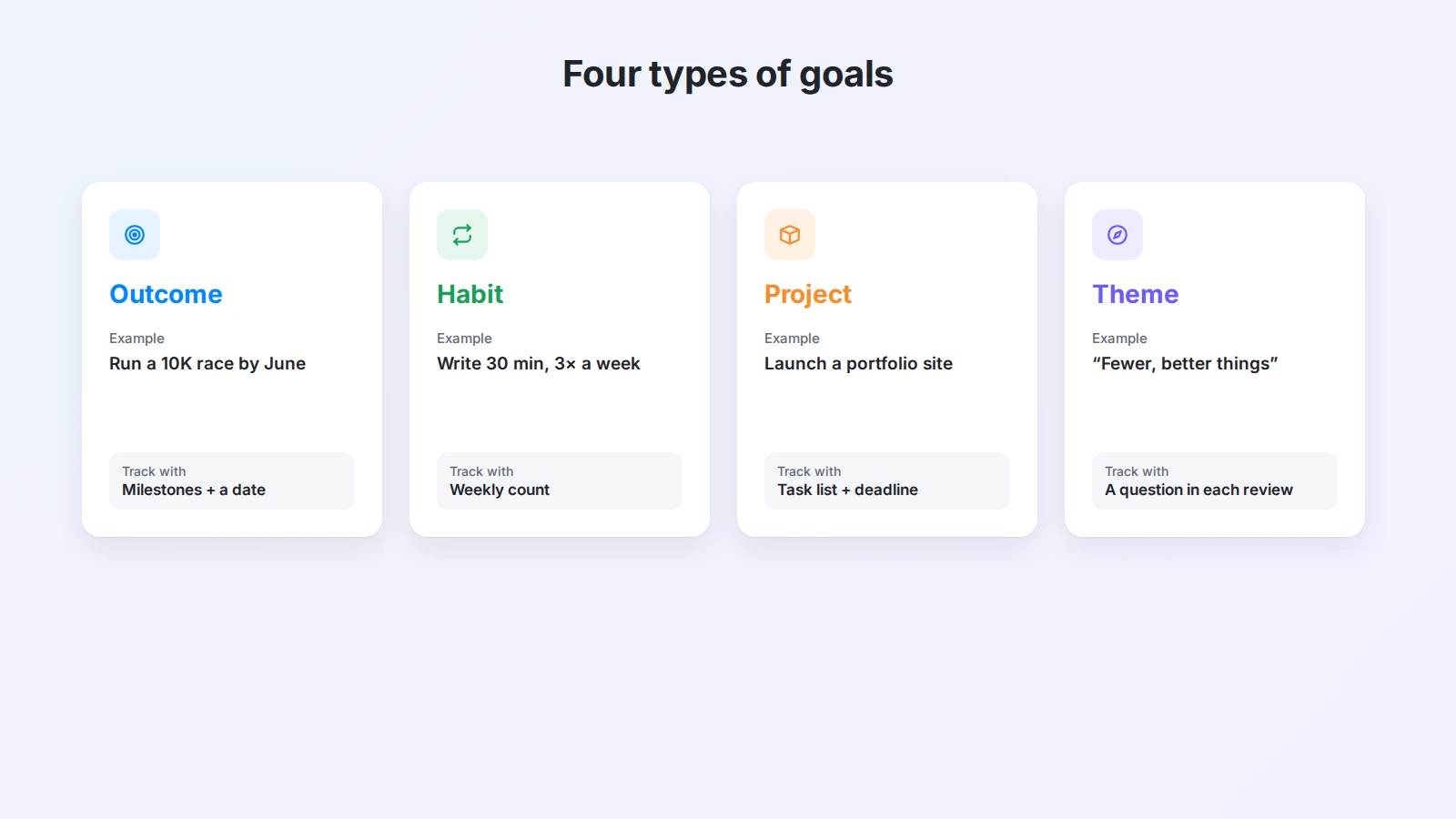
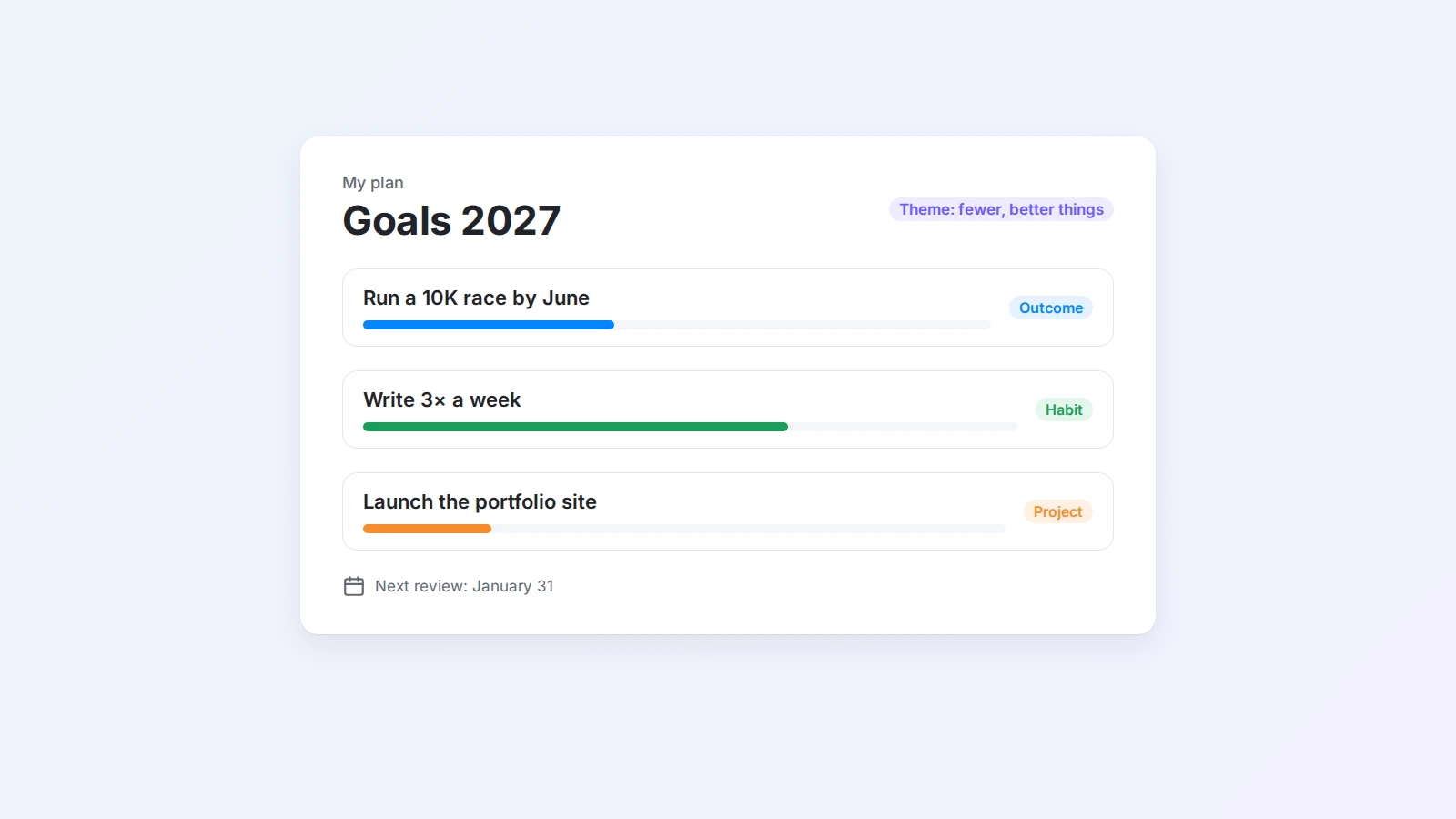
Outcome goals benefit from the SMART approach: specific, measurable, achievable, relevant, and time-bound. Habit goals usually work better with a simple rule ("three times a week") than with a big number ("100 runs this year"), because one missed week does not break the whole goal. A theme is optional, but it helps you decide when new opportunities appear during the year. For more on goal frameworks, see our guide to using OKRs.
Step 4: Write a one-page goal card
A goal written in one line is easy to forget. A short card makes it concrete. For each goal, write:
- Goal: one sentence with a clear finish line
- Why it matters: the reason you will remember in March, when motivation is low
- What done looks like: the result or the habit rule
- Milestones: two to four checkpoints across the year
- First step: a task you can finish in under an hour
- Obstacles and plan: what will probably get in the way, and what you will do then
- Review date: when you will check it next
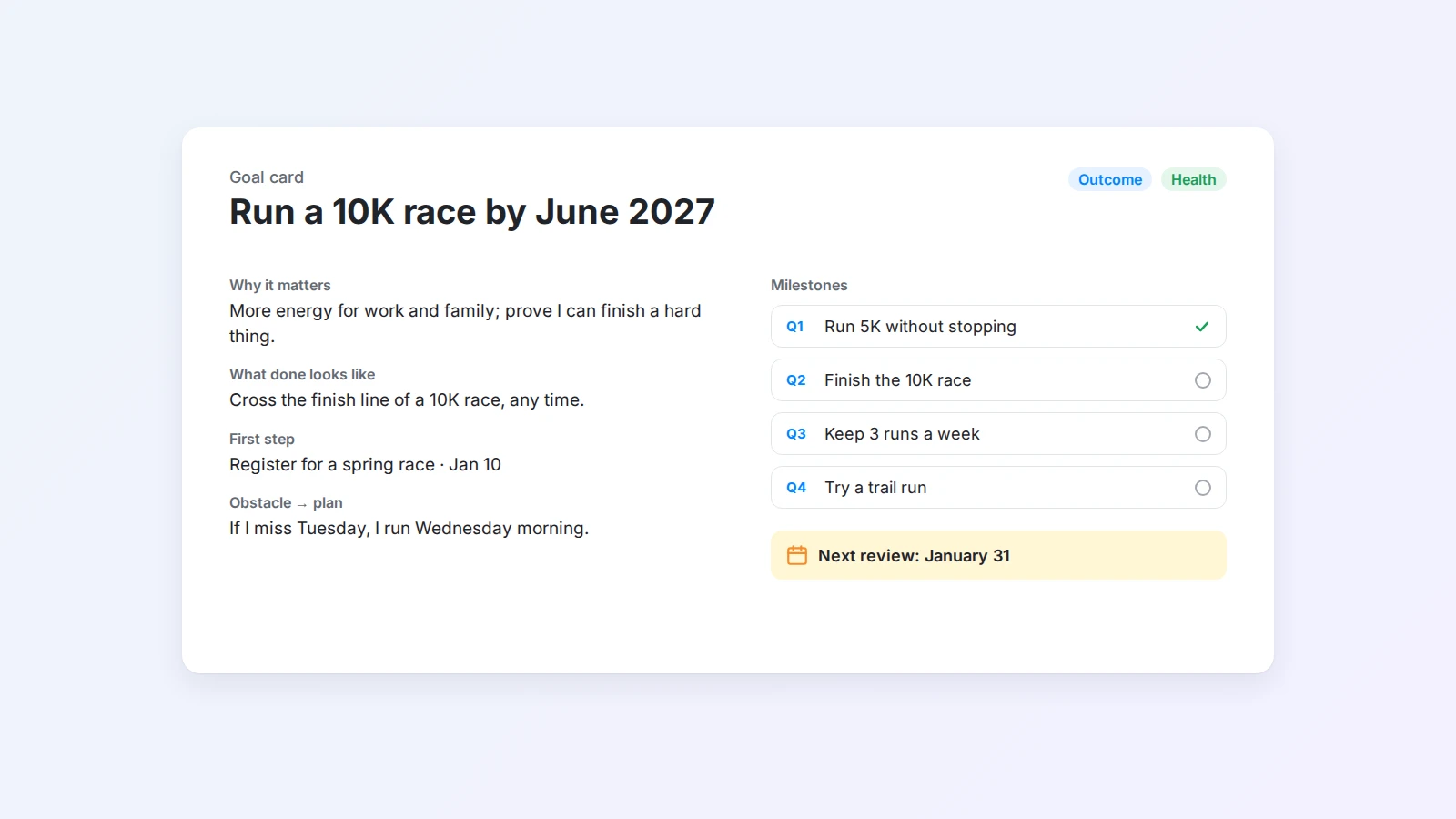
The "obstacles and plan" line is the one people skip, and it is one of the most useful. Planning for the likely problem in advance, such as "If I miss a run on Tuesday, I run on Wednesday morning", makes it much easier to recover than deciding in the moment.
Step 5: Plan the first 30 days
The first month sets the tone. Instead of waiting for January 1, prepare in December:
- Schedule the first step for each goal in the first week of January.
- Remove one obstacle, such as buying running shoes, booking a course, or setting up an automatic transfer to savings.
- Tell one person about the goal, if that helps you.
- Set your review dates in the calendar now: one short monthly review and four quarterly reviews.
If a goal has no clear first step yet, the first step is to define it. That is a real task, and it belongs in your calendar too.
Step 6: Review monthly, adjust quarterly
Reviews are what keep goals alive. They do not need to be long.
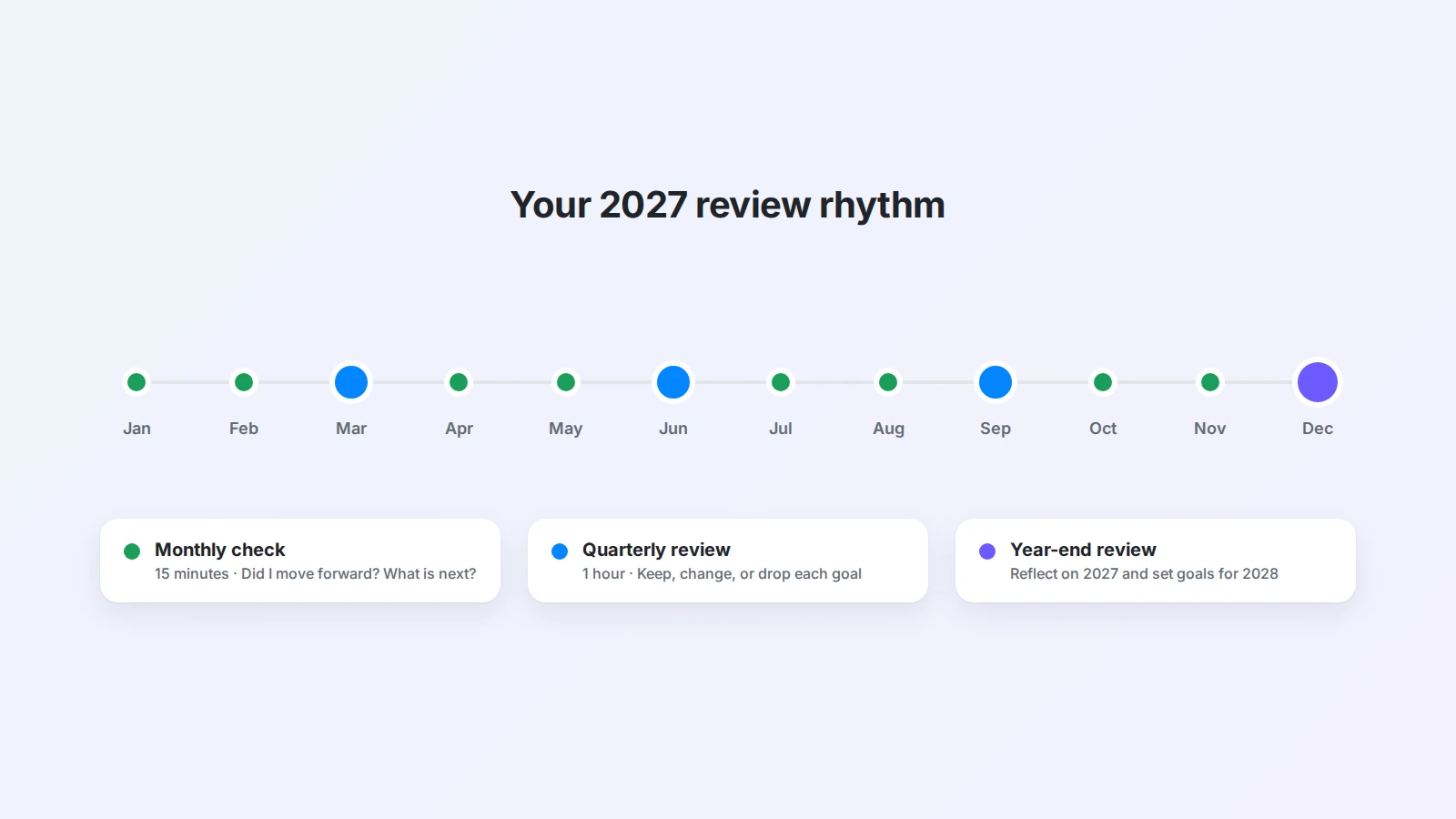
- Monthly (15 minutes): For each goal, ask: did I move forward? What is the next step? Is anything blocking me?
- Quarterly (one hour): Look at the milestones. Keep, change, or drop each goal. Promote a goal from the someday list if you have space.
- December 2027: Do a full year-end review and set goals for 2028.
When a goal is behind, choose one of three options: shrink the next step, move the deadline, or drop the goal. All three are fine. Carrying a dead goal for the rest of the year is the only bad option.
Examples of goals for 2027
Use these as inspiration, not as a list to copy.
| Area | Wish | Clear goal for 2027 |
|---|---|---|
| Health | Get fit | Run a 10K race by June, training three times a week |
| Career | Grow at work | Lead one cross-team project and present the results by Q3 |
| Money | Save more | Build an emergency fund of three months of expenses by December |
| Learning | Learn a language | Hold a 20-minute conversation in Spanish by October |
| Relationships | See friends more | Host one dinner or trip with friends every month |
| Creativity | Write more | Publish 24 blog posts, two per month |
| Rest | Work less | Take one fully offline weekend every month |
Track your 2027 goals in Buildin
A goals system works best when it is in the same place as your daily tasks and notes. In Buildin, you can keep everything on one page:
- Create a Goals 2027 database with properties for type, status, life area, and next review date. Each goal becomes a page with its goal card.
- Link tasks to goals. First steps and milestones live in your task list, linked to the goal they move forward.
- Add a habit tracker for habit goals, with one row per week.
- Use a review template. The weekly goals and review template works for monthly check-ins too.
- Ask AI for help. Buildin Agent can turn a long list into grouped themes, rewrite a vague goal into a clear one, or summarize your progress before a quarterly review.
Common mistakes to avoid
- Setting goals on January 1 in a hurry. Plan in December, start in January.
- Making every goal a big outcome. Mix in at least one habit. Habits build progress even in months when outcomes feel far away.
- Treating the plan as fixed. A quarterly change is not failure; it is the plan working.
- Measuring only results. Also count the inputs you control, such as training sessions or writing hours.
Final thoughts
Good goals for 2027 are not the most ambitious ones. They are the ones that fit your life, have a clear finish line, and get looked at regularly. Review 2026, choose three goals, write a card for each, schedule the first step, and put twelve short reviews in your calendar.
To start, close this year with our year-end review guide, then build your goal cards in Buildin for free.

Amara Elara
Specializes in visualizing complex processes and improving product education. Responsible for user support, product tutorials, and visual guides at Buildin, helping users improve tool adoption and overall productivity.