How to do a year-end review: reflect on 2026 and plan 2027 (free template)
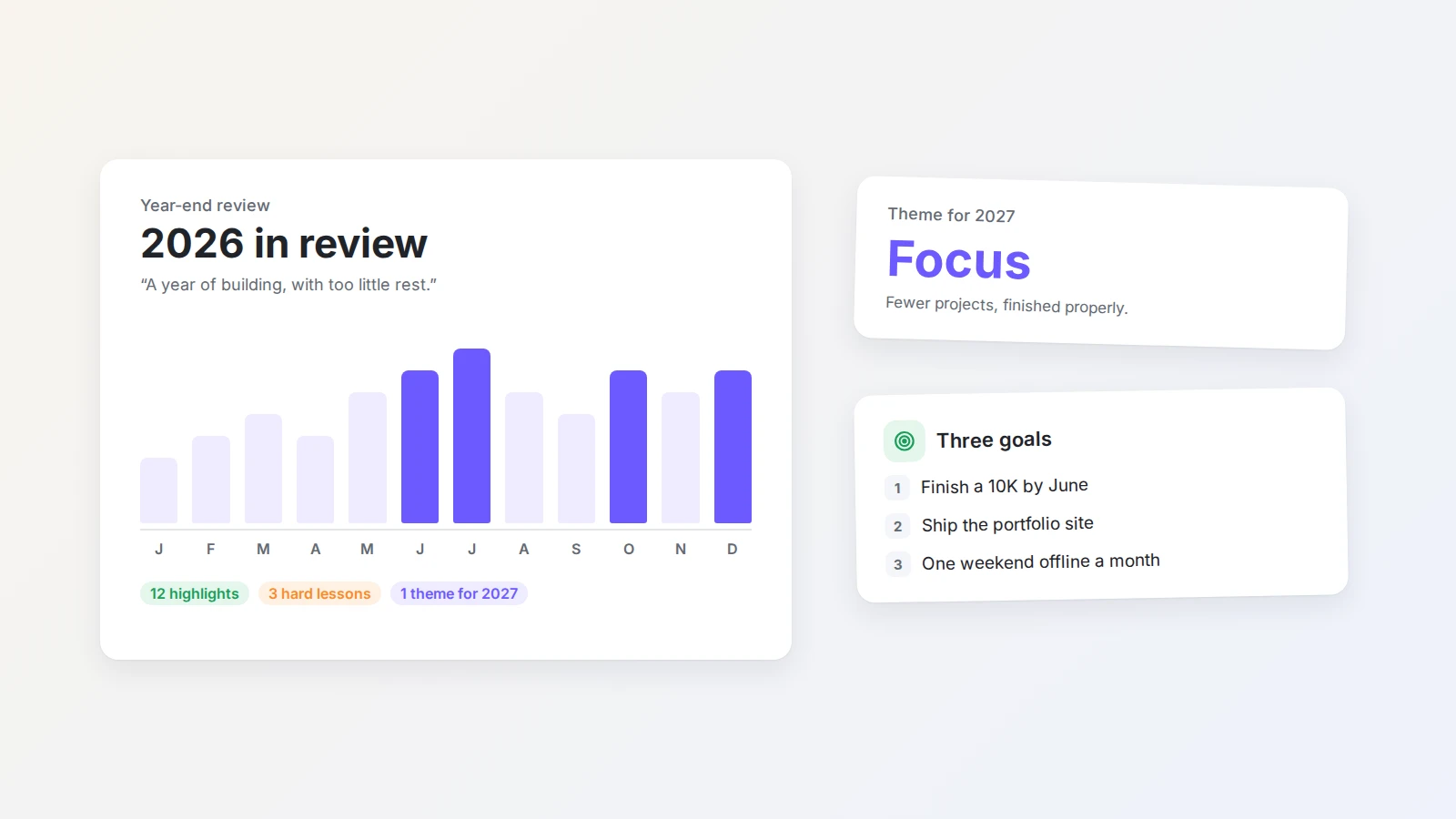
A practical year-end review in six steps: gather your year, score each life area, name what to keep, stop, and start, choose a theme and three goals for 2027, and turn them into a 90-day plan. Includes 30 reflection questions and a free template.
The end of the year has a way of arriving all at once. One week you are planning the fourth quarter; the next, it is mid-December and the year is a blur of projects, trips, and calendar invites you barely remember.
A year-end review slows that blur down. It is a structured look back at the past twelve months: what happened, what mattered, what you learned, and what you want to do differently. Done well, it is the most useful two or three hours of planning you will spend all year, because it turns twelve months of experience into a short list of decisions.
This guide walks through a year-end review in six steps, gives you 30 reflection questions, and ends with a free template you can copy into Buildin or any notes app.
The short answer
To do a year-end review, set aside two sessions of about 90 minutes. In the first, gather your year — calendar, photos, notes, and finished projects — then score each area of your life from 1 to 10 and list your highlights and hardest moments. In the second, decide what to keep, stop, and start, choose one theme for the coming year, set no more than three goals, and turn them into a plan for the first 90 days. Put a quarterly check-in in your calendar before you close the page.
Why a year-end review works better than resolutions
New Year resolutions are written on January 1 from a mix of guilt and optimism. Most of them are vague (“get fit,” “be more organized”), unconnected to what actually happened last year, and forgotten by February.
A year-end review reverses the order. You start with evidence: what you did, what it cost you, and what it gave you. Patterns become visible. You notice that your best months had something in common, or that one commitment quietly consumed your energy. The goals you set afterwards are smaller, more specific, and grounded in what you now know about yourself.
It also gives the year a proper ending. Writing down what you finished and what you learned turns a blur into a story you can look back on.
Before you start: gather your year
You remember far less of the year than you think. Before you reflect, collect the raw material, so your review is based on what happened rather than on the last few weeks.
Spend 20–30 minutes skimming:
- Your calendar. Scroll month by month. Note trips, events, launches, and weeks that were unusually full or empty.
- Photos. Your camera roll is a surprisingly honest record of what you cared about.
- Notes and journal entries. If you keep a daily journal or weekly reviews, they are the richest source you have.
- Finished work. Projects completed, documents written, courses finished, books read.
- Money. A quick look at major spending shows where your priorities actually went.
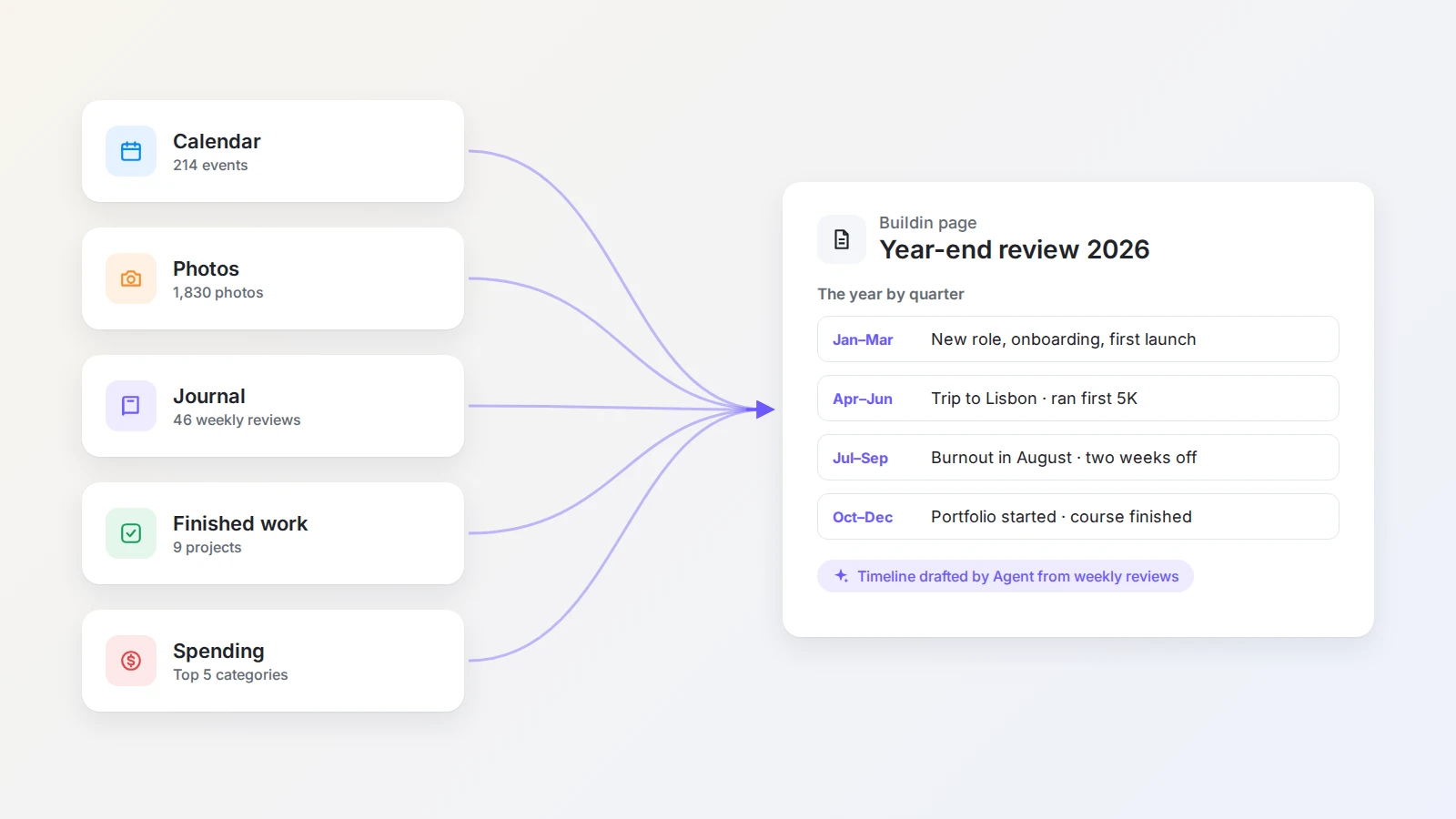
If your notes live in Buildin, let AI do the first pass. Ask Buildin Agent to “read my weekly reviews from this year and list the main events, recurring themes, and unresolved questions by month.” It reads your pages and databases and drafts a timeline you can correct and add to. Treat it as a memory aid, not a verdict; the reflection is still yours.
Step 1: Score each area of your life
A year is too big to judge as a whole. Break it into areas and give each a score from 1 (very unsatisfied) to 10 (fully satisfied). The point is not precision; it is to see where the year felt strong and where it felt thin.
| Area | Question to ask |
|---|---|
| Work and career | Did my work feel meaningful, and did I grow? |
| Money | Do I feel more or less secure than a year ago? |
| Health and energy | How did my body and sleep feel most weeks? |
| Relationships | Who did I get closer to, and who did I drift from? |
| Learning | What new skill or knowledge did I actually use? |
| Fun and rest | Did I have enough time that was not productive? |
| Home and environment | Did my space support the life I want? |
| Personal growth | In what way am I different from a year ago? |
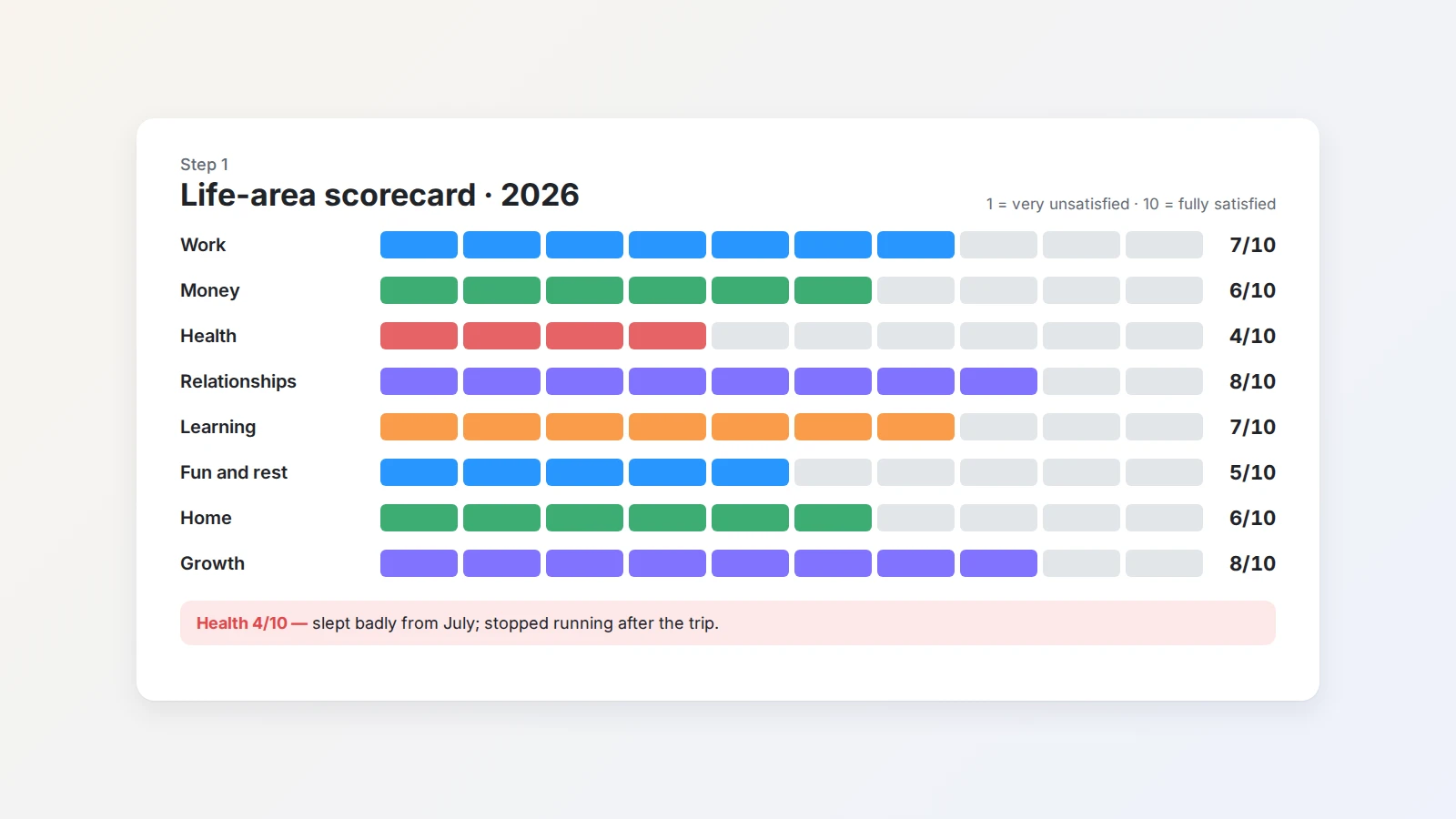
Write one sentence next to each score explaining why. Those sentences are more valuable than the numbers. If you want a visual version, the wheel of life method turns the same scores into a chart, and the wheel of life template is ready to fill in.
Step 2: List your highlights and hardest moments
Now go back through the material you gathered and write two lists.
Highlights: the moments, achievements, and experiences you are proud of or grateful for. Include small ones. A great conversation counts as much as a promotion.
Hardest moments: what went wrong, what you struggled with, and what you lost. Write these without judging yourself. The goal is to understand, not to grade.
Aim for at least ten highlights. Most people undercount them, and seeing a long list changes how the whole year feels.
Step 3: Answer the reflection questions
With the year laid out in front of you, work through the questions below. You do not have to answer all 30. Pick the ones that make you pause.
Looking back
- What were the three best moments of the year?
- What am I most proud of?
- What took most of my time, and was it worth it?
- What was the hardest thing I went through, and how did I handle it?
- What did I start that I did not finish? Why?
- What surprised me most?
- Who had the biggest influence on my year?
- What did I spend money on that I am glad about, and what do I regret?
- Which month felt best, and what was different about it?
- What did I avoid that I knew I should face?
Understanding why
- What gave me the most energy this year?
- What drained my energy most consistently?
- Which habits helped me, and which held me back?
- What did I say yes to that I should have declined?
- What did I learn about how I work best?
- Which decision would I make again without hesitation?
- Which decision would I change, and what would I do instead?
- What did I believe at the start of the year that I no longer believe?
- Where did I compare myself to others, and did it help?
- What do I want to remember about this year in ten years?
Looking ahead
- What do I want more of next year?
- What do I want less of?
- What is one thing I keep postponing that would make everything easier?
- Who do I want to spend more time with?
- What skill would change the most if I improved it?
- What would make next year feel like a success, even if nothing else changed?
- What am I willing to give up to make room for what matters?
- What does a normal, good week look like for me next year?
- What one word describes the year I want?
- What is the first small step I will take in January?
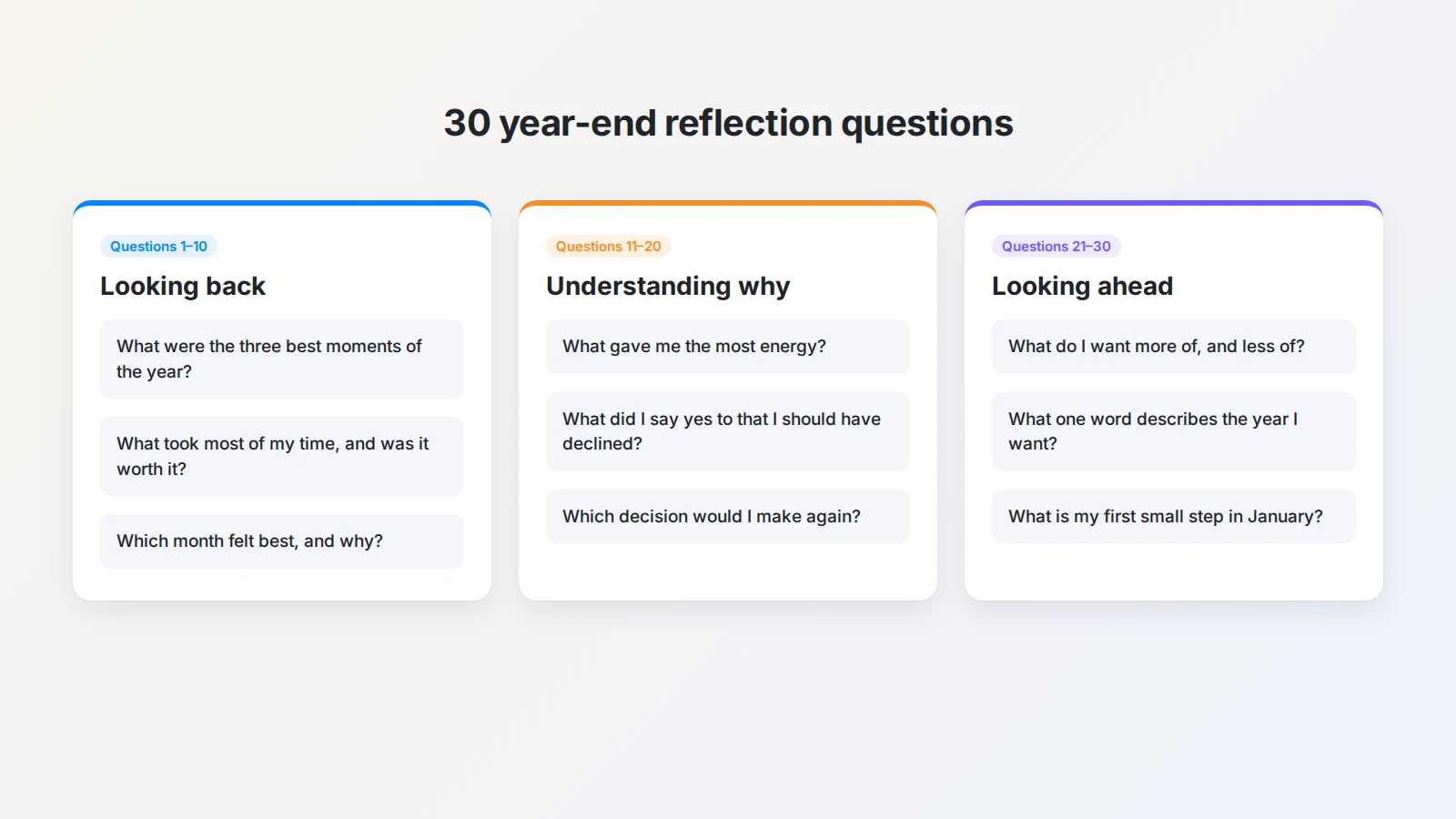
Write your answers in full sentences when you can. Short answers hide vague thinking; a full sentence forces you to decide what you actually mean.
Step 4: Decide what to keep, stop, and start
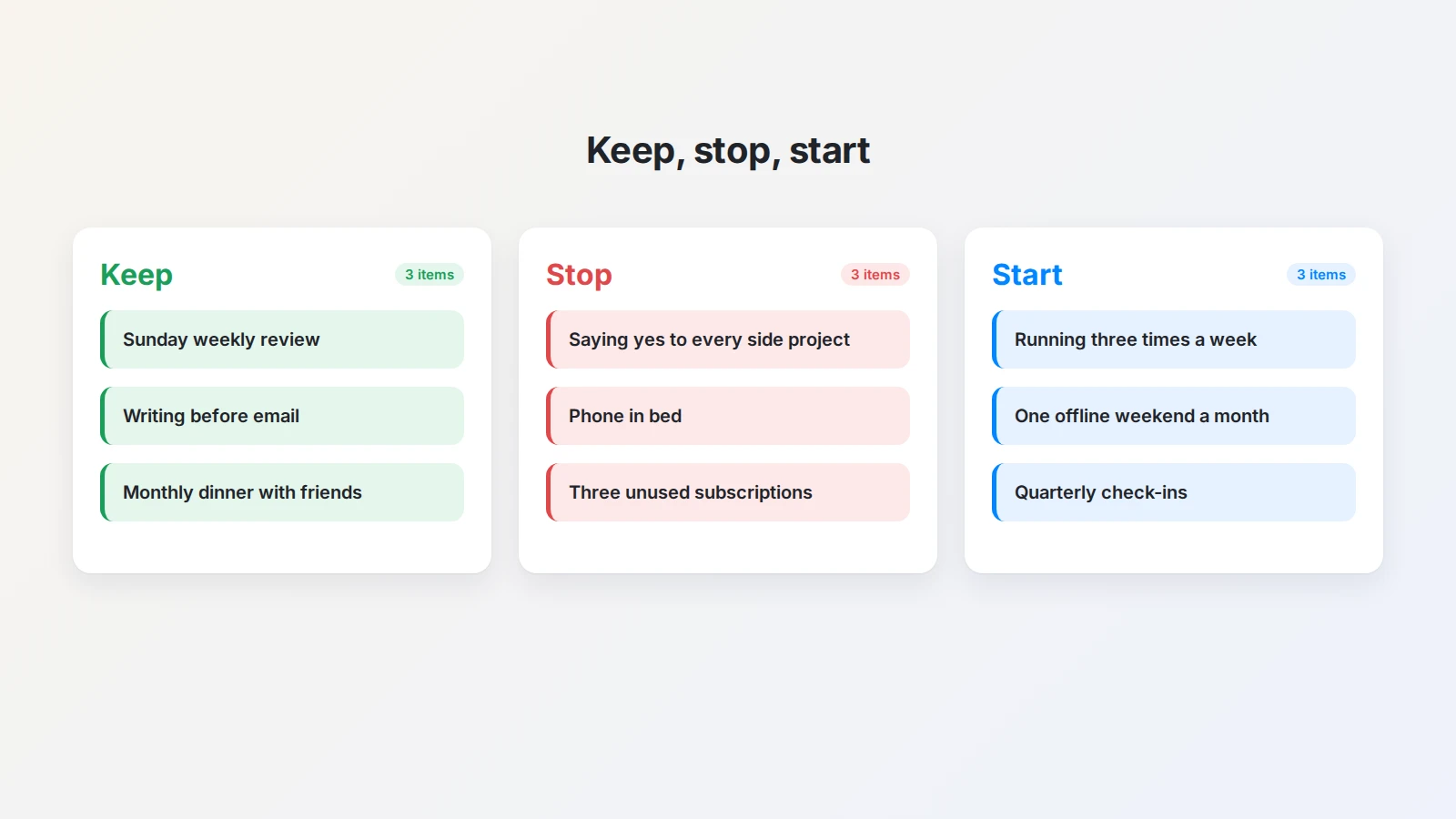
This is where reflection becomes action. Read back through your scores, lists, and answers, and sort what you find into three columns:
- Keep: what worked and deserves to continue. A habit, a routine, a relationship, a way of working.
- Stop: what cost more than it gave. A commitment, a subscription, a pattern, a project that has run its course.
- Start: what is missing. Something your best months had and your hardest months lacked.
Limit each column to three or four items. A long list of stops and starts is just another list of resolutions.
Step 5: Choose a theme and no more than three goals
Before setting goals, choose a theme or a single word for the year: focus, health, build, slow down, connect. A theme is a filter. When an opportunity appears mid-year, you can ask whether it fits the theme instead of deciding from scratch.
Then set no more than three goals. Each one should:
- Come directly from your review (a low score, a “start” item, a repeated question).
- Describe a result you will recognize when it happens.
- Have a first step you can take in January.
For example, if health scored a 4 and your best months included regular exercise, a good goal is “Run three times a week and finish a 10K by June,” with the first step “Register for a spring race and schedule three runs in the first week of January.”
If you want help shaping goals, the goal setting workbook walks through each one, and a vision board can make your theme visible every day.
Step 6: Turn goals into a 90-day plan
A year is too long to plan in detail. Plan the first 90 days instead, and review again at the end of each quarter.
For each goal, write:
- What “done” looks like by the end of March. A milestone, not the whole goal.
- Three to five actions that get you there.
- The habit or routine that keeps it moving week to week.
- One obstacle you can predict, and how you will handle it.
Then put four dates in your calendar right now: one check-in at the end of each quarter. The review only works if you come back to it.
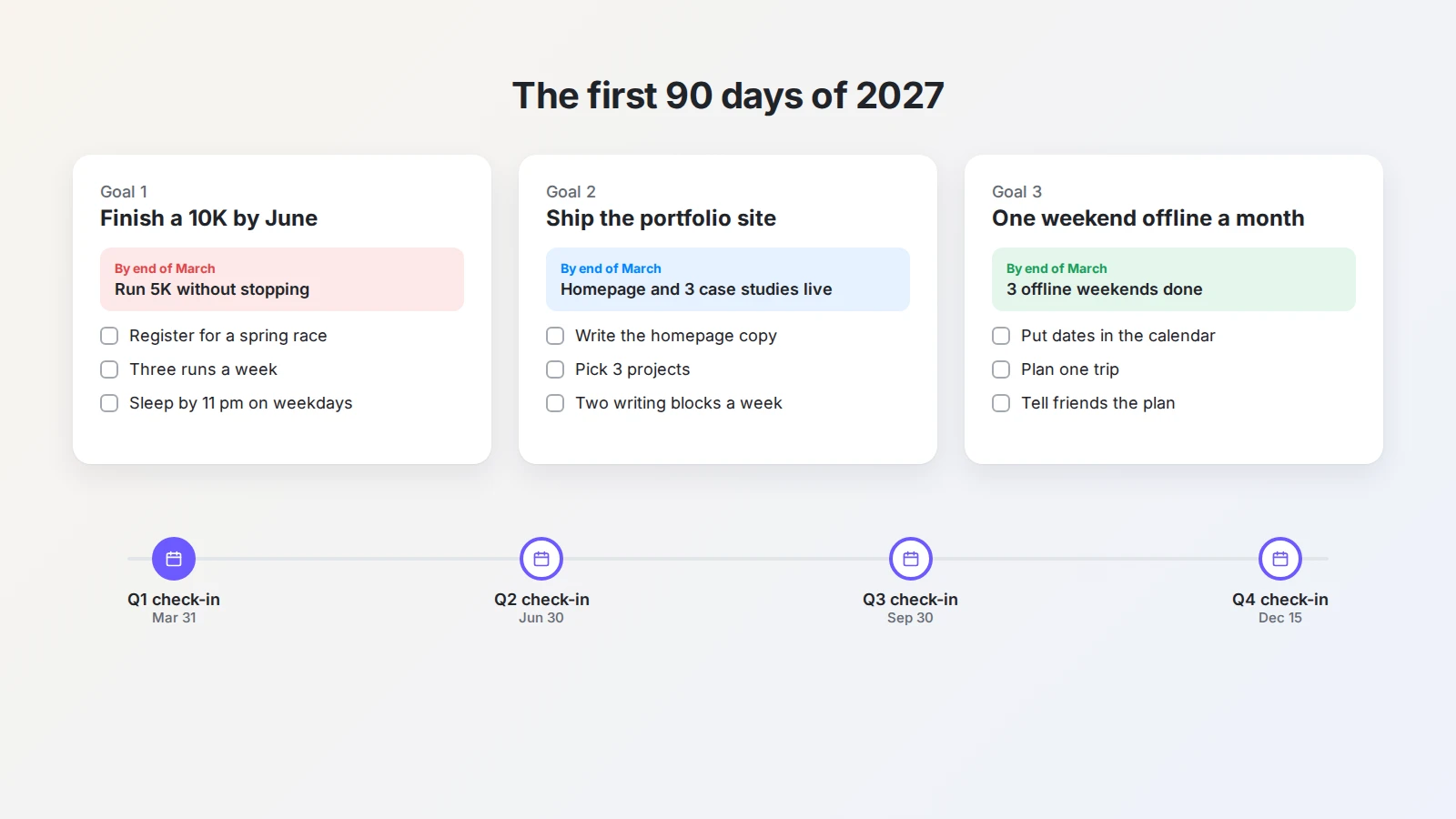
In Buildin, you can keep your goals in a small database with properties for theme, quarter, status, and next step, and link each goal to your weekly reviews. That way, your weekly goals and review page shows which goal each week is moving forward, and the next year-end review almost writes itself.
A year-end review for teams
The same structure works for a team, with a few changes. Ask everyone to fill in a short version individually first: highlights, hardest moments, keep/stop/start. Then meet to combine the answers, look for patterns, and agree on three priorities for the next year. Connect those priorities to your quarterly goals or OKRs so the review leads directly to planning.
Keep the team review in a shared workspace rather than a slide deck. Next December, the team can open last year’s page and see what it decided and what actually happened.
Free year-end review template
Copy this structure into a Buildin page and fill it in over two sessions. If you prefer a ready-made version, start from the annual review template.
Year-end review 2026
1. My year in a sentence: …
2. Life-area scores (1–10) and why: Work · Money · Health · Relationships · Learning · Fun · Home · Growth
3. Highlights (at least ten): …
4. Hardest moments: …
5. Reflection questions: answers to the questions that made me pause
6. Keep / Stop / Start: three or four items in each
7. Theme for 2027: one word or phrase
8. Three goals for 2027: result, why it matters, first step in January
9. Q1 plan: milestone, actions, weekly habit, likely obstacle for each goal
10. Check-in dates: end of March, June, September, December
Common mistakes to avoid
Doing it all in one sitting
Reflection and planning need different energy. Split them across two sessions, a few days apart, so you plan with a clear head.
Only listing what went wrong
A review that only covers failures leaves you discouraged and less likely to try again. Start with highlights.
Setting too many goals
Ten goals means none of them gets real attention. Three is plenty; one is often enough.
Skipping the first step
A goal without a January action stays an intention. Decide the very first move before you close the page.
Never looking at it again
The review is only as useful as the check-ins that follow. Put the quarterly dates in your calendar now.
Final thoughts
A year-end review is not about judging the year. It is about understanding it well enough to make next year a little more intentional.
Gather your year, score each area, list your highlights and hardest moments, answer the questions that matter, decide what to keep, stop, and start, and leave with one theme, three goals, and a 90-day plan.
Open Buildin, create a page called “Year-end review 2026,” and book two 90-minute sessions before the holidays. Next December, you will be glad you did.

Amara Elara
Specializes in visualizing complex processes and improving product education. Responsible for user support, product tutorials, and visual guides at Buildin, helping users improve tool adoption and overall productivity.