What Is a Life Checklist? And How to Build One You'll Actually Stick To

Learn what a life checklist is, why most fall apart, and how to build one you'll actually stick to — with a free 100-item template.
Everyone carries a "someday" list in their head: someday I'll see the northern lights, someday I'll write a book, someday I'll take my parents on a trip. The problem is, "someday" rarely arrives — not because these things are too hard, but because they only exist in your head.
A life checklist is how you write those "somedays" down and actually manage them. This article covers three things: what a life checklist actually is, why most people's checklists fall apart, and how to build one you'll genuinely use for years.
What is a life checklist?
A life checklist is a written list of the things you want to experience, accomplish, or become in your lifetime. It's not a task management tool — it's a menu for your life. You don't have to order everything on the menu, but it helps you remember what you actually want to eat.
A good life checklist has three traits:
- It's experience-centered. Items are "do a thing," not "reach a state." "Run a half marathon" is a checklist item; "stay healthy" isn't.
- It spans multiple life domains. Travel, health, career, family, creativity, adventure… not just work goals or vacation spots.
- It can be tracked and reviewed. Every item has a status, and the list gets opened regularly — not written once and left to gather dust.
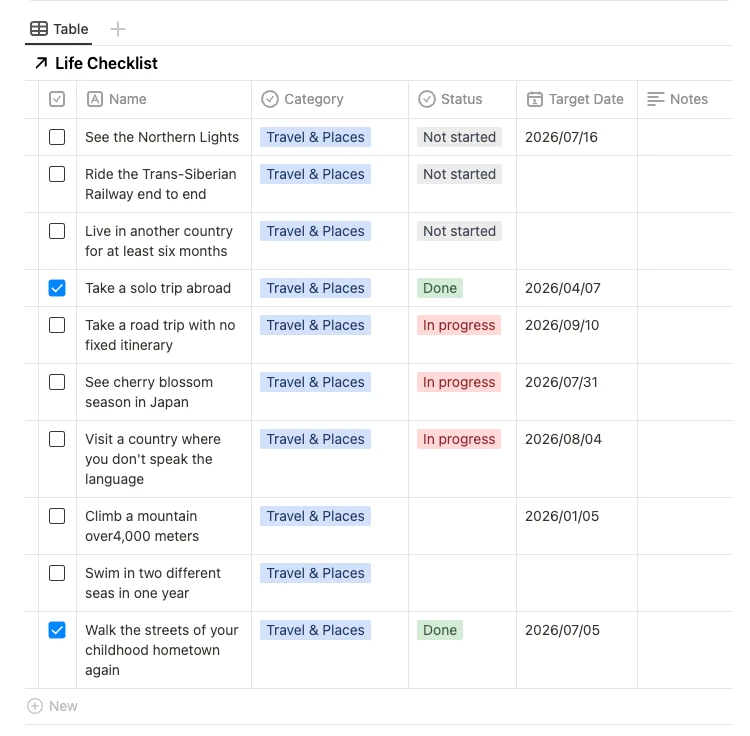
Life checklist vs bucket list vs to-do list
These three terms get used interchangeably, but their tone and usage are quite different:
| Life checklist | Bucket list | To-do list | |
|---|---|---|---|
| Time span | A lifetime, evolving as you live | Implies "before I die" | Days to weeks |
| Tone | A menu: order what you like | A pact: regret if unchecked | Tasks: do it, cross it off |
| Item types | Mostly experiences, some achievements | Mostly grand dreams | Mostly mundane chores |
| Do items get deleted? | Yes, swap anytime | Rarely | Often |
In short: a to-do list manages your next week, a bucket list defines your finish line, and a life checklist keeps you company through the whole journey.
Why most life checklists fall apart
Plenty of people have written a life checklist — and then? Nothing. The list sits in a notes app, opened twice a year. There are five common reasons:
1. The items are too vague. "Get out more" and "learn something" have no finish line, which means they're never finished. Compare that with "climb a 4,000-meter mountain" — the moment you stand on the summit, you know it's done.
2. You copied someone else's dreams. A downloaded "100 things to do before you die" list looks inspiring, but half of it probably doesn't interest you. Items that don't move you won't get done — they just manufacture guilt.
3. There are only two states: done and not done. On a 100-item list, 95 items say "not done" — every time you open it, you're reminded how far behind you are. Without an in-between state, the list becomes an anxiety machine.
4. It's never reviewed. An unreviewed list is just a wish list. Writing it felt great; three months later you've forgotten it exists.
5. All-or-nothing thinking. Treating 100 items as a pact that must be fully completed means the moment you fall behind, you abandon the whole thing.
What these problems share: the checklist gets treated as a static document, not a living system. The six steps below are the fix for those five failure modes.
How to build a life checklist you'll actually stick to
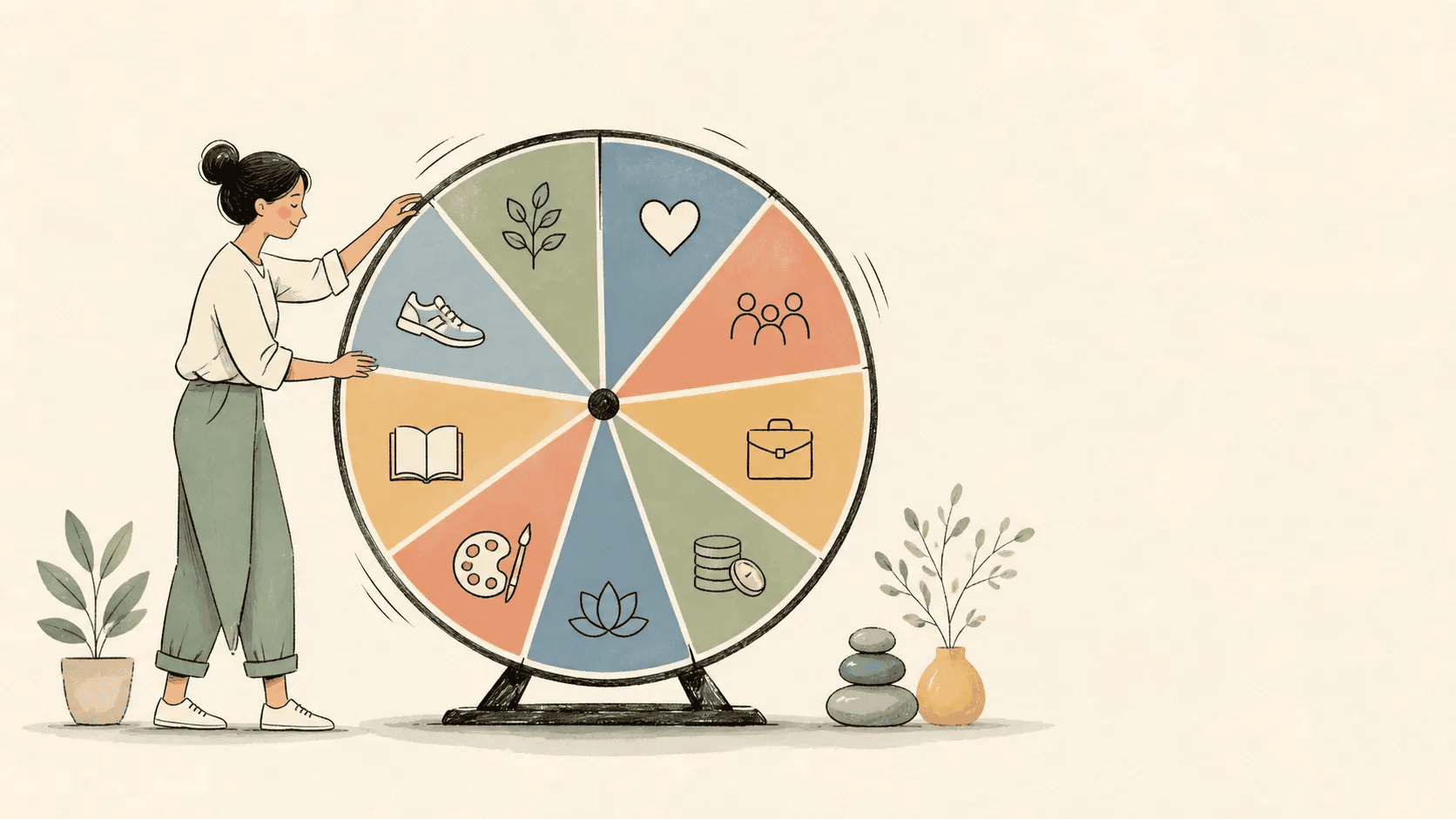
Step 1: Brainstorm by life domain, don't just jot things down
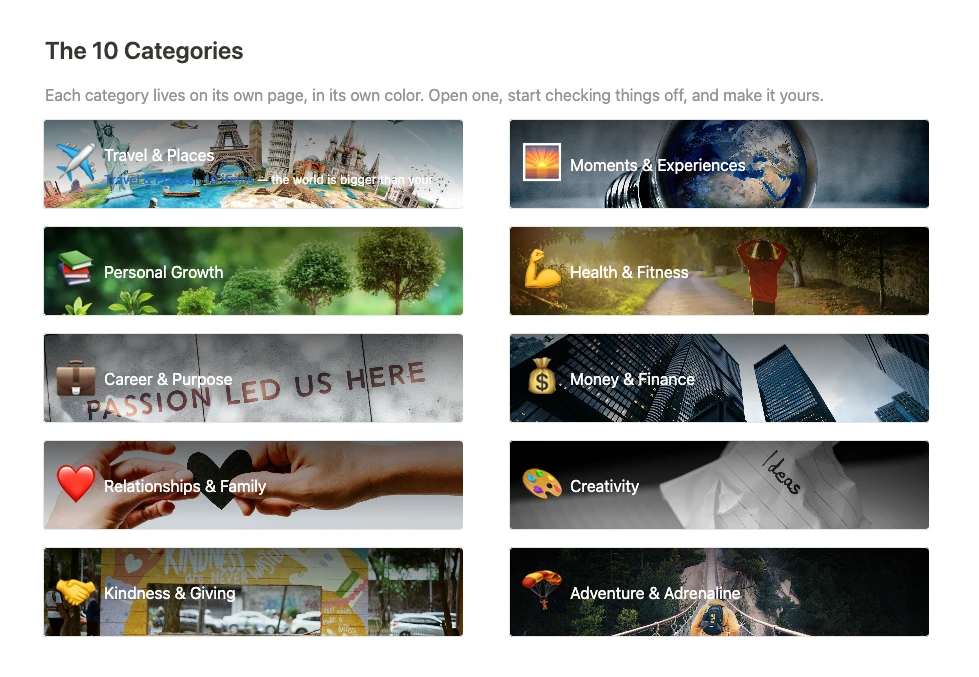
Jotting items at random gets you 20 travel items, and item 21 is filler. A better approach: define the domains first, then fill each one — travel, experiences, growth, health, career, finances, relationships, creativity, kindness, adventure… five to ten items per domain.
This structure forces you to think about dimensions you'd never come up with on your own — like "kindness." Few people list it spontaneously, yet "donate blood once" or "buy a stranger a coffee" are among the most satisfying things to complete.
Step 2: Write items as concrete experiences
The formula for a good item: verb + a specific standard or scenario.
- ❌ "Spend more time with family" → ✅ "Interview your grandparents and record their stories"
- ❌ "Learn something" → ✅ "Master one signature dish"
- ❌ "Read more" → ✅ "Write a book, or keep a blog going for a full year"
The test: a year from now, can you say without any hesitation "this one's done"? If yes, it's a good item.
Step 3: Give every item a status, not just a checkbox
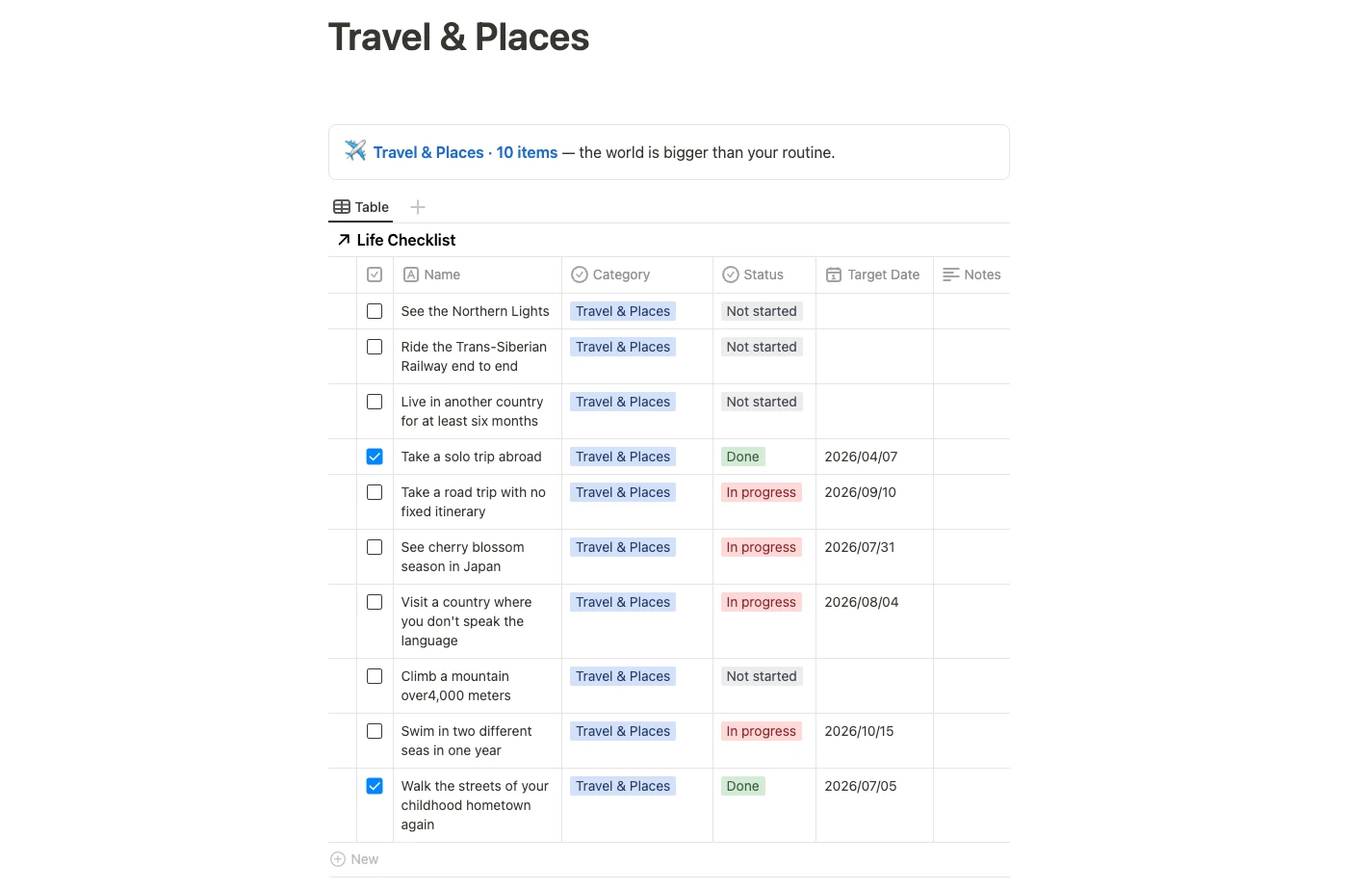
Each item gets exactly three states: Not started (it's on the menu, you haven't ordered it yet — nothing wrong with that), In progress (the flight is booked, you've been training for three weeks), Done (experienced, checked off).
"In progress" is the key: it turns the list from a wall of "95 items undone" anxiety into a progress panel of "here are the 5 things I'm doing." Open the list and you don't see debt — you see life happening.
Step 4: Set target dates for only a few items
Don't put deadlines on all 100 items — that's not a life checklist, that's a KPI sheet. Target dates go only to the two or three "in progress" items: the ones you want to finish this quarter get a real day on the calendar.
A date's job isn't to be a deadline — it's to turn "someday" into "before September 10." With a date, you start booking flights, reading guides, requesting time off. The item goes from wish to plan.
Step 5: Review for ten minutes every quarter
Four times a year, ten minutes each: in Q1, pick the 10 items that excite you most this year and set a date for the one you'll do this quarter; in Q2, check progress and attach photos or notes to completed items; in Q3, make a mid-year adjustment — swap out anything that no longer excites you, guilt-free; in Q4, celebrate what's done, and either roll the rest into next year or delete it decisively.
Step 6: Let yourself change it anytime
A life checklist is a menu, not a pact: 100 items is a starting point, not a ceiling. Add, delete, and swap whenever you like. Completion isn't the point — the point is waking up with something to look forward to.
Start with a ready-made template
We built this whole system into a free Buildin template — **Life Checklist**:
- 100 pre-loaded items, organized across 10 life-domain pages, each with its own color scheme
- Three-state tracking: Not started / In progress / Done, plus target dates and notes
- In-progress panel + a trophy wall of completions: the homepage shows what you're doing and what you've done in real time
- One master database: all 100 items in a single table, with board view and grouping by domain
- Built-in quarterly review: the Q1–Q4 questions above live at the bottom of the page — just answer them
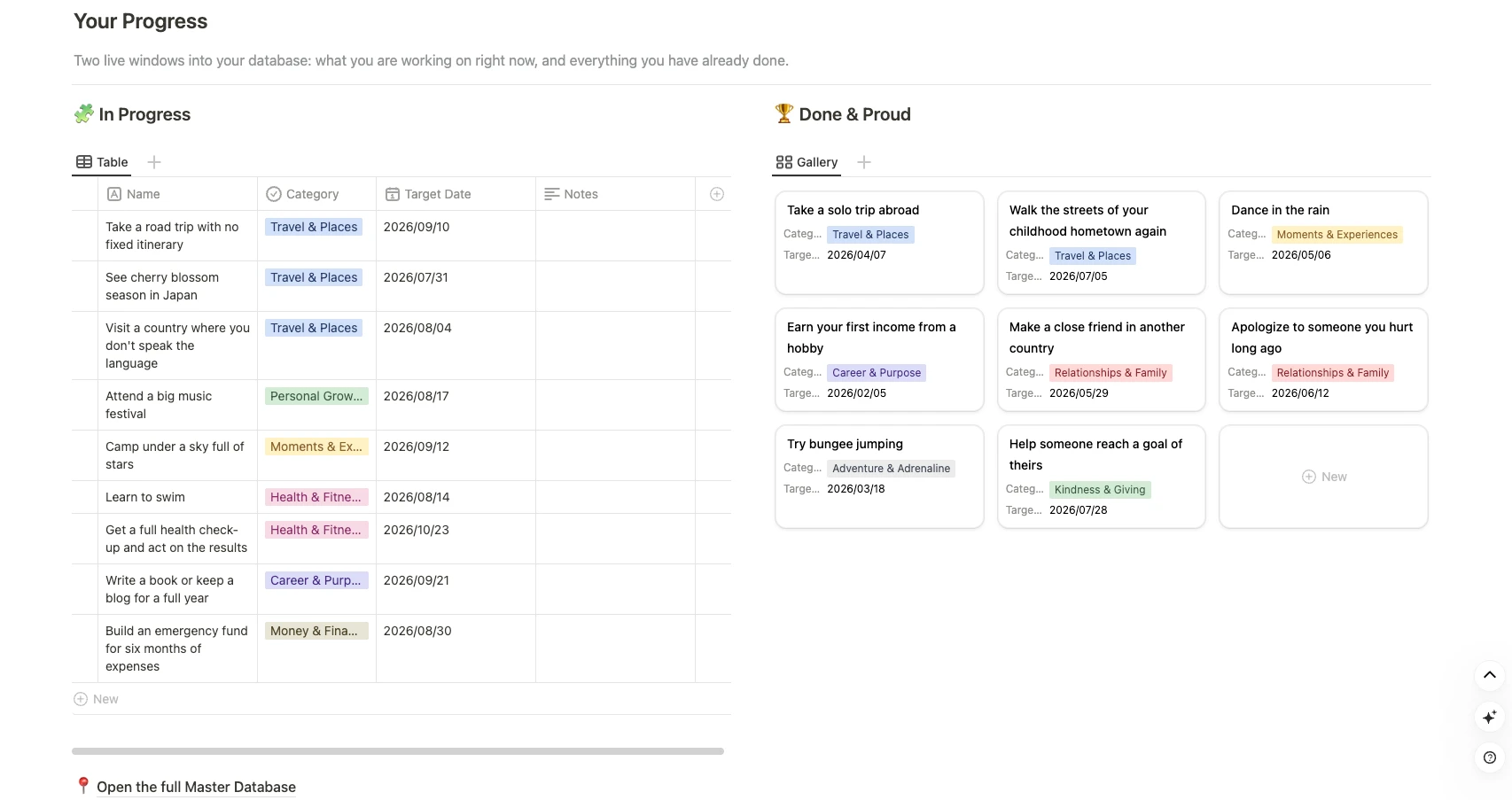
Every page writes back to the same database, so each item is entered exactly once. Open the template, duplicate it, and check off your first item this week.
👉Get the free Life Checklist template
FAQ
How many items should a life checklist have?
There's no standard answer, but 100 is a good starting point: enough to cover every dimension of a life, not so many you want to close the tab at a glance. What matters is that every item excites you — no filler.
How often should I review it?
Once a quarter, ten minutes each time, is just right. More often becomes a burden; once a year makes it easy to forget entirely. Put the review on your calendar and tie it to the change of seasons.
What if I finish all 100 items?
Celebrate first — that's remarkable. Then you'll understand what "completion isn't the point" means: write another 100.
What if some items will never get done?
Delete them, or rewrite them into versions you actually want. The list serves you — not the other way around.
Final thoughts
Eleanor Roosevelt put it well: "The purpose of life is to live it, to taste experience to the utmost, to reach out eagerly and without fear for newer and richer experience."
A life checklist won't make you live longer, but it will remind you to live. No need to wait for a perfect starting point — open the list and finish one item this week.

Amara Elara
Specializes in visualizing complex processes and improving product education. Responsible for user support, product tutorials, and visual guides at Buildin, helping users improve tool adoption and overall productivity.