Wheel of Life: Evaluate 9 Areas, Find Imbalances, and Make an Action Plan

Use the Wheel of Life to evaluate nine areas, spot imbalances, and turn your results into a practical 30-day action plan in Buildin.
You spent hours making a list of goals. Every goal seemed reasonable, yet two weeks later everything stalled. The problem is usually not self-discipline but the list itself: every goal belongs to the same area of life. You added three career goals and none for family, health, or rest. Before long, your body and emotions remind you what has been left out. This usually means your life is out of balance.
The Wheel of Life is a tool for making that imbalance visible. It divides life into several areas, asks you to rate your satisfaction with each one from 0 to 10, and connects the points on a chart. You can immediately see where the wheel is round and where it dips. This guide explains how to use the Wheel of Life, choose honest scores, and turn the result into an action plan.
What is the Wheel of Life?
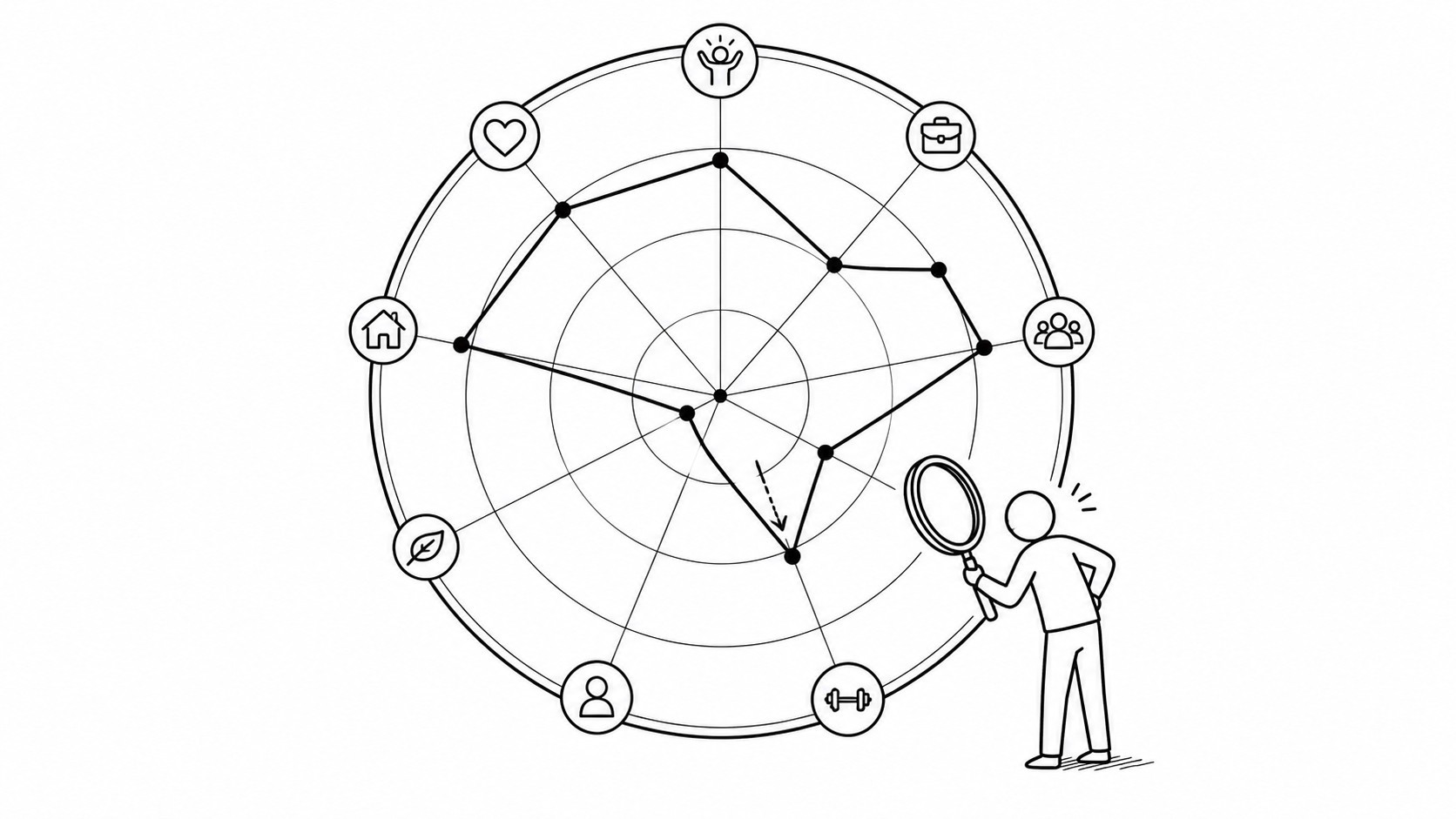
The Wheel of Life is a circular self-assessment chart. The circle is divided into equal sections, with each section representing one area of life. The center is 0 and the outer edge is 10. You rate your satisfaction with every area, mark each score on the corresponding radius, and connect the points.
The resulting shape is the answer. The closer it is to an even circle, the more evenly your attention is distributed. The deepest dip points to an area you may have neglected. The wheel does not offer solutions on its own. It does one useful thing: it turns a vague feeling such as “something is off” into a concrete observation such as “rest is at 3 out of 10.”
The Wheel of Life originated as a coaching tool that helped clients identify which areas needed attention first. Today, people also use it for personal reviews at the start of a year, once a quarter, or whenever life seems to have lost direction.
9 areas of life on the wheel
The classic Wheel of Life often has eight sections. A nine-area version separates one broad category into two, so that every section represents a single idea and you do not have to average two different answers.
One common set of nine areas is:
- Career and education: work, professional development, or study
- Finances: income, savings, debt, and financial security
- Health: sleep, exercise, nutrition, and medical checkups
- Family: the quality of relationships with a partner, parents, or children
- Friends and social connections: close relationships and your wider social circle
- Love and intimacy: the depth of romantic or marital relationships; if this area is not relevant, you can replace it
- Personal growth: new skills, reading, and developing your thinking
- Hobbies and creativity: activities you do for enjoyment rather than results
- Rest and recreation: relaxation, travel, and time without productive tasks
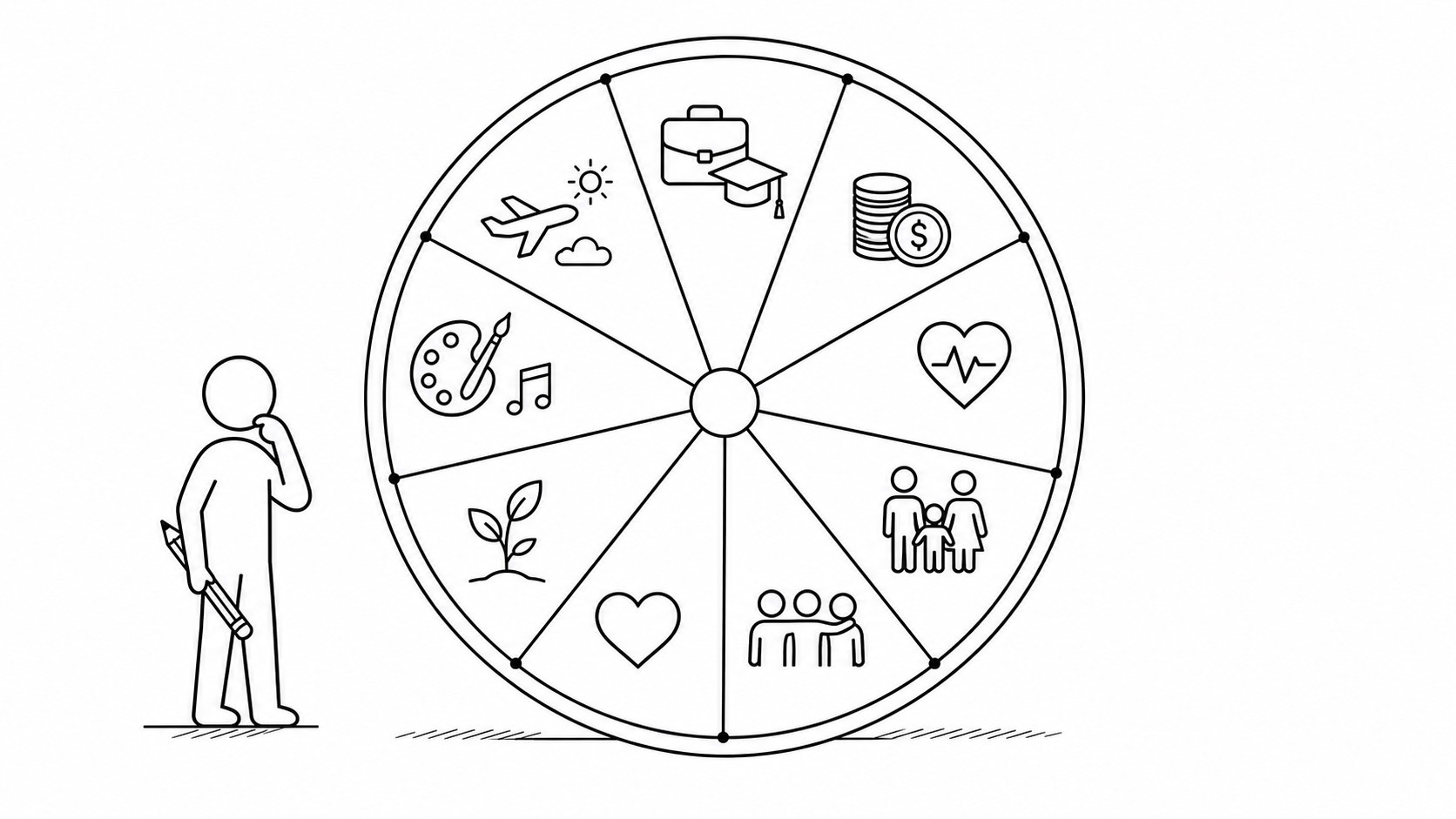
The set of areas is not fixed. Some people make “living environment” a separate area, while others combine finances and career. The only requirement is that every area matters to you independently and that you can assign it a score without wondering which category it belongs to.
How to choose your scores
Scoring looks easy, but this is where many people go wrong. A score is subjective—and it should be. You are measuring satisfaction, not an objective level of success. Someone with a high income may still give finances a 4 if their debt feels risky.
Three principles make the assessment more accurate:
Ask the same question for every area. Use one fixed question: “How satisfied am I with this area over the past month?” This makes the scores comparable. Do not judge career by achievement while judging health only by whether you were ill.
Focus on the last two to four weeks. Looking too far back can inflate a score because you remember better periods. The wheel measures your current state, not your historical best.
Trust your first reaction. The number that first comes to mind is often the most honest. If you deliberate for too long, you may end up rating how things should be rather than how they are.
Once you have nine scores, place them on the chart. A typical pattern might be career 8, finances 7, health 4, and rest 3. The sharp difference between the highest and lowest scores shows where your life has become unbalanced.
How to read your wheel
When your chart is complete, do three things.
Find the one or two areas with the lowest scores. Ignore the rest for the moment and record the minimum. Low-scoring areas often drain energy continuously, even when you are not paying attention. Someone who is chronically sleep-deprived may maintain a high career score, but only by using up their reserves.
Look for connections between high and low areas. Some imbalances are structural. A career score of 9 beside a family score of 3 is often a cause-and-effect relationship: one area is being supported at the expense of another. Understanding which area is paying for another matters more than simply raising the lowest score.
Look at the spread, not just the absolute scores. A wheel made entirely of fives may be less urgent than one ranging from 8 to 3. A difference of more than three or four points suggests that resources are being distributed unevenly.
You do not need a score of 10 in every area. That is neither realistic nor necessary. The purpose is to understand why the scores look as they do and whether you accept that distribution. Career 8 and rest 4 can be a conscious choice during a three-month product launch. That is fine when it is deliberate, temporary, and has a known cost. Life balance is not an average score; it is an awareness of what each score costs.
From assessment to an action plan
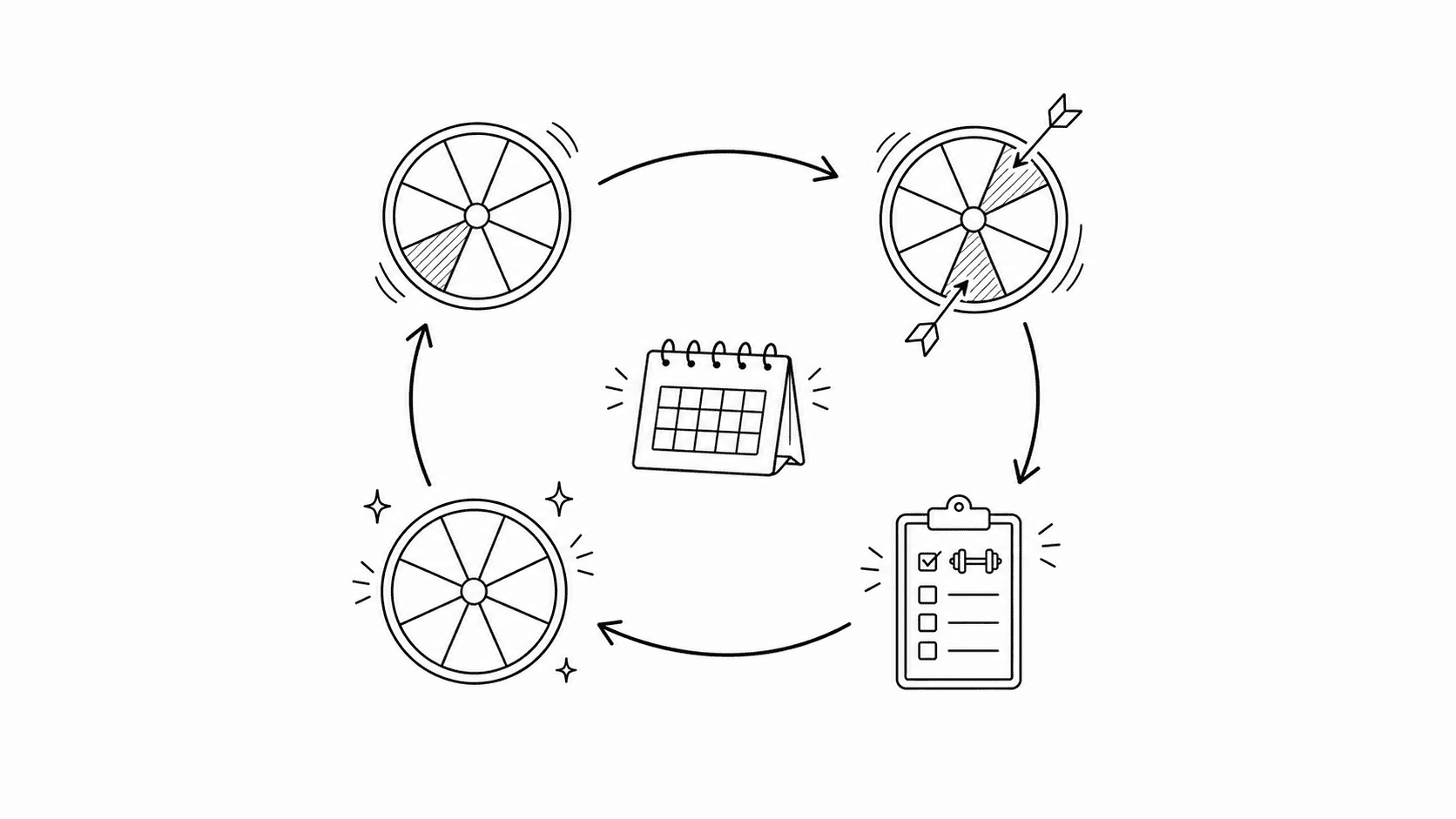
An assessment that remains only a picture is not useful. The action plan is the second half of the exercise and has four steps.
Step 1: Describe the current state of each low-scoring area in one sentence. Write a fact, not a number. Instead of “rest: 3,” write “For the past two weeks, I have slept six hours a night and answered work messages on weekends.” A concrete description gives you something to compare in a month.
Step 2: Choose only one or two areas to work on. Trying to change five areas at once usually means none of them changes. Ask whether improving one area is likely to support the others. Health is often a useful starting point because better sleep and energy can also improve career and family life.
Step 3: Give each selected area one small action for 30 days. The action should be easy enough to complete consistently. “Restore my health” is not actionable; “exercise for 30 minutes three times a week” or “go to bed before 11 p.m. for two weeks” is.
Step 4: Draw the Wheel of Life again after 30 days. Compare the new scores with the old ones. Check whether the selected area improved and whether another area suffered. The wheel is not a one-time diagnosis but a recurring review tool; only repeated measurements show which direction your balance is moving.
A common mistake is turning the action plan into a wish list. “Spend more time with family” is not an action. “Have dinner with my family on Wednesdays without my phone” is. Every item should answer one question: what exactly will I do today or this week?
How to build a Wheel of Life in Buildin
You can draw the wheel on paper, but keeping it in your notes makes long-term review easier. All your assessments remain together, so you can see how scores and actions change instead of drawing a new wheel each time and throwing it away.
In Buildin, you can organize the process into four blocks that match the cycle above.
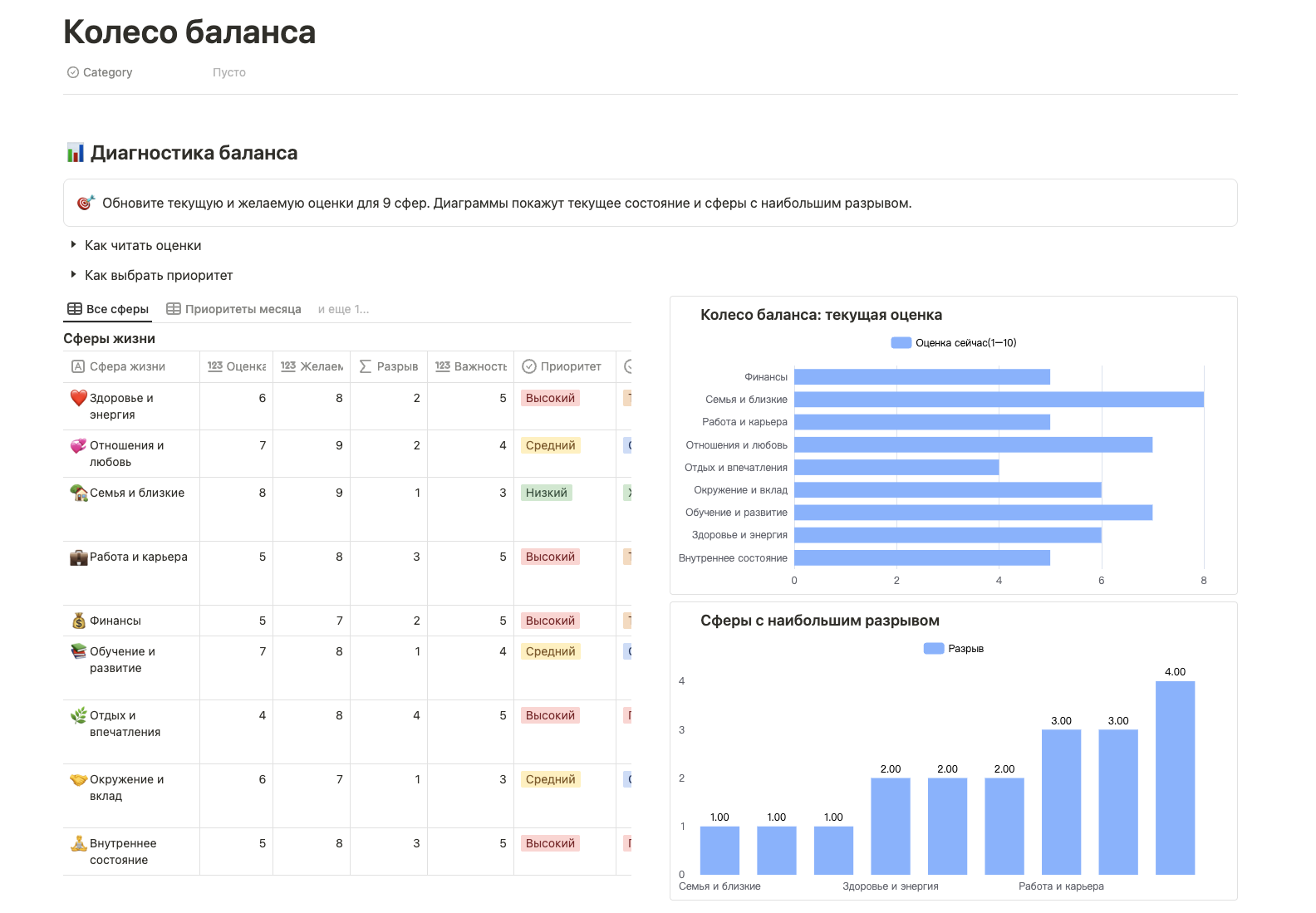
The first block is a score table. Store the nine areas in a database with one row per area and columns for the current and desired scores. Their difference is the gap. The area with the largest gap becomes obvious. Add each new assessment with a date and sort the database over time to see which areas are improving and which are standing still.
The second block is an action plan. Give every action its own row with fields for the area, next concrete step, estimated time, deadline, and priority. Once you choose one or two key areas, mark their actions as high priority. Other ideas can remain on the list without creating pressure to change everything at once.
The third block is a habit tracker. When a 30-day action works, turn it into a habit and continue tracking it. “Go to bed before 11 p.m.” moves from a one-time action to a habit with a frequency and weekly target. The action plan covers the current month; the habit tracker helps the improvement continue afterward.
The fourth block is a weekly review. Once a week, record three numbers—energy, mood, and sense of balance—on a scale from 1 to 10, followed by a short reflection. These numbers respond faster than the nine monthly scores. A new imbalance often appears in the weekly review first.
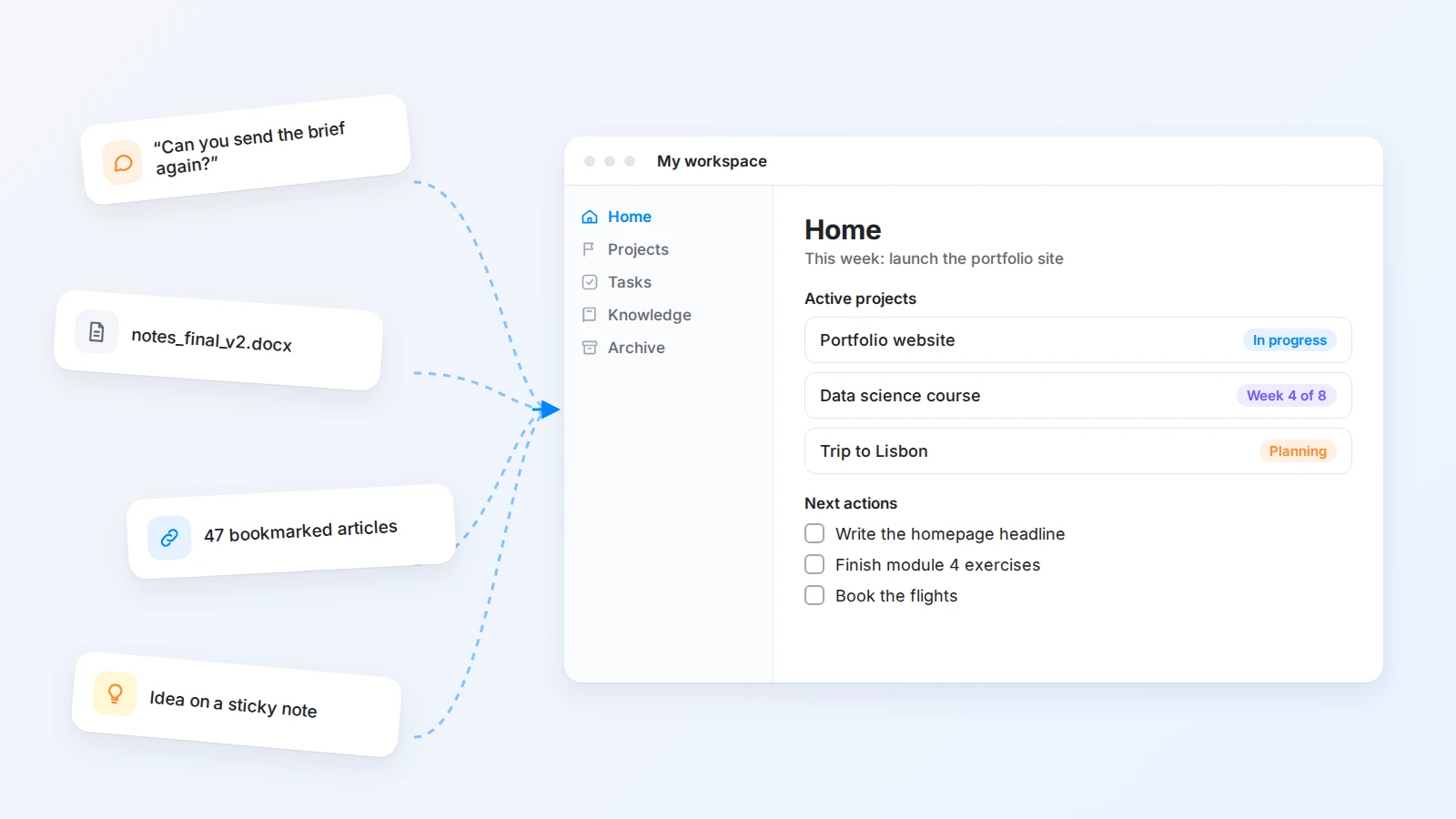
All four blocks live in one workspace: assessment, actions, habits, and review. Nothing needs to be moved between apps. You do not need the full system immediately. A score table and action plan are enough for the first monthly cycle; add the habit tracker and weekly review after the first 30 days.
Frequently asked questions
How often should I complete the Wheel of Life?
During a period of active change, once a month works well and matches the length of the action-plan cycle. When life becomes more stable, once a quarter is enough. Going more than six months without a review increases the chance that an imbalance will grow unnoticed.
Are the Wheel of Life and the life balance wheel the same thing?
Yes. They are two names for the same tool: a divided circle used to rate satisfaction with different areas of life.
Does a low score mean I must fix it immediately?
Not necessarily. A low score can be a conscious choice, such as accepting less rest while starting a business. Make sure the choice has a clear cost and an end date: “I accept a score of 4 for the next three months, then I will reassess it.”
Can I use a different number of areas?
Yes. A practical range is eight to ten sections. With fewer than six, categories start to overlap; with more than ten, the boundaries become unclear and your actions become scattered. Choose areas that reflect your own life rather than someone else’s template.
Can couples or teams complete the Wheel of Life together?
Yes, and it can be especially useful. Two people score the areas independently and then compare. Discovering that one person rates the same area at 7 while the other gives it 4 can be an excellent starting point for a conversation.
Final thoughts
A list of goals often fails before execution begins because it covers only one corner of life. The Wheel of Life lets you see the whole picture before adding more pressure to one area. One assessment takes about ten minutes. It will not prevent every problem, but it will show what you are trading for what you have. Life balance is not a destination; it is a process that needs regular review.

Amara Elara
Specializes in visualizing complex processes and improving product education. Responsible for user support, product tutorials, and visual guides at Buildin, helping users improve tool adoption and overall productivity.