How to write a self-evaluation for your performance review (30+ examples)
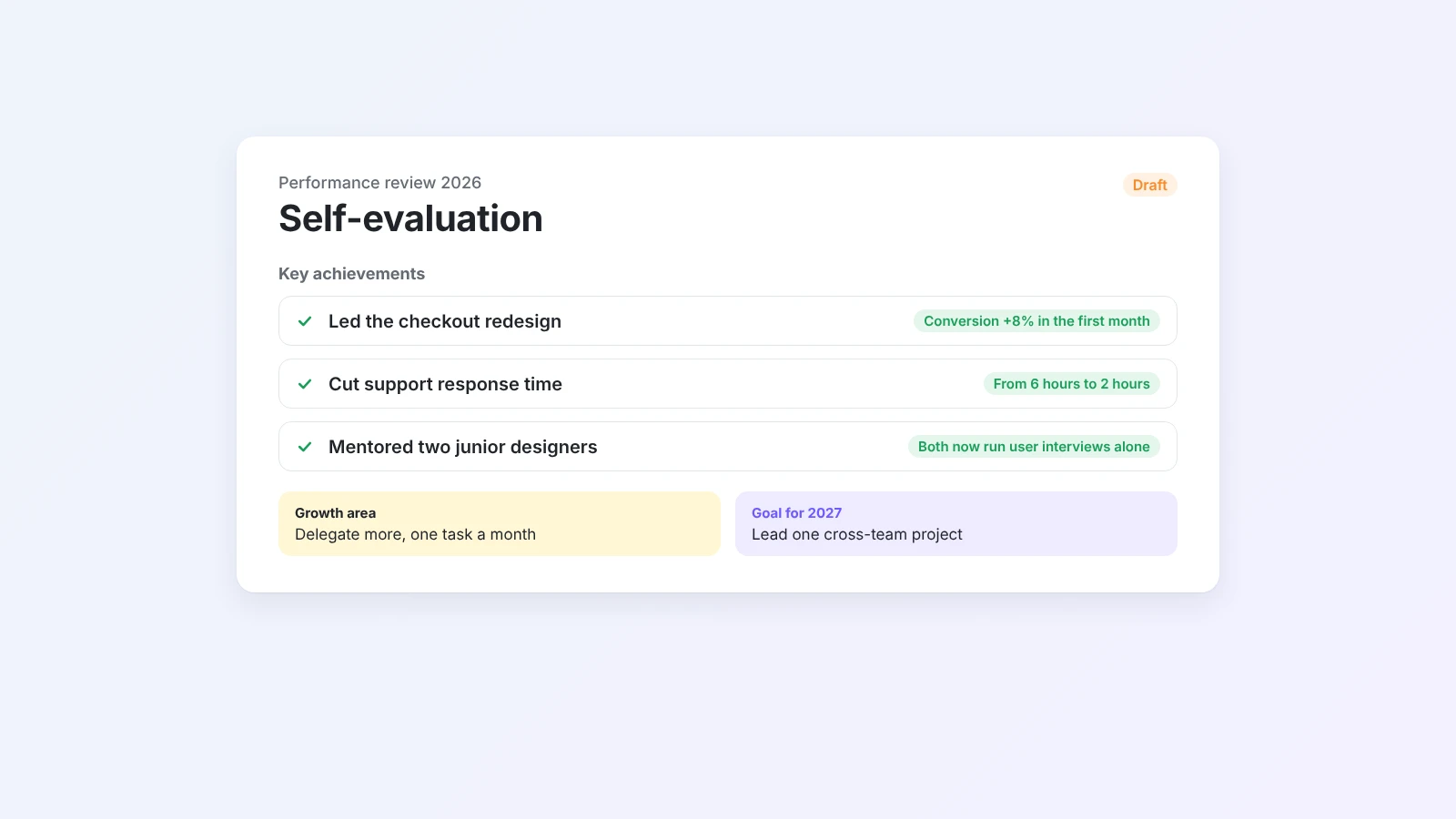
A self-evaluation is your chance to tell the story of your year before anyone else does. Here is how to write one in five steps, with the STAR method, 30+ example phrases by skill, and a simple way to collect evidence all year so next time takes minutes.
Every year, the same thing happens. The review form opens, the deadline is Friday, and you stare at a blank box that asks you to summarize twelve months of work. You remember the last few weeks clearly and almost nothing from March.
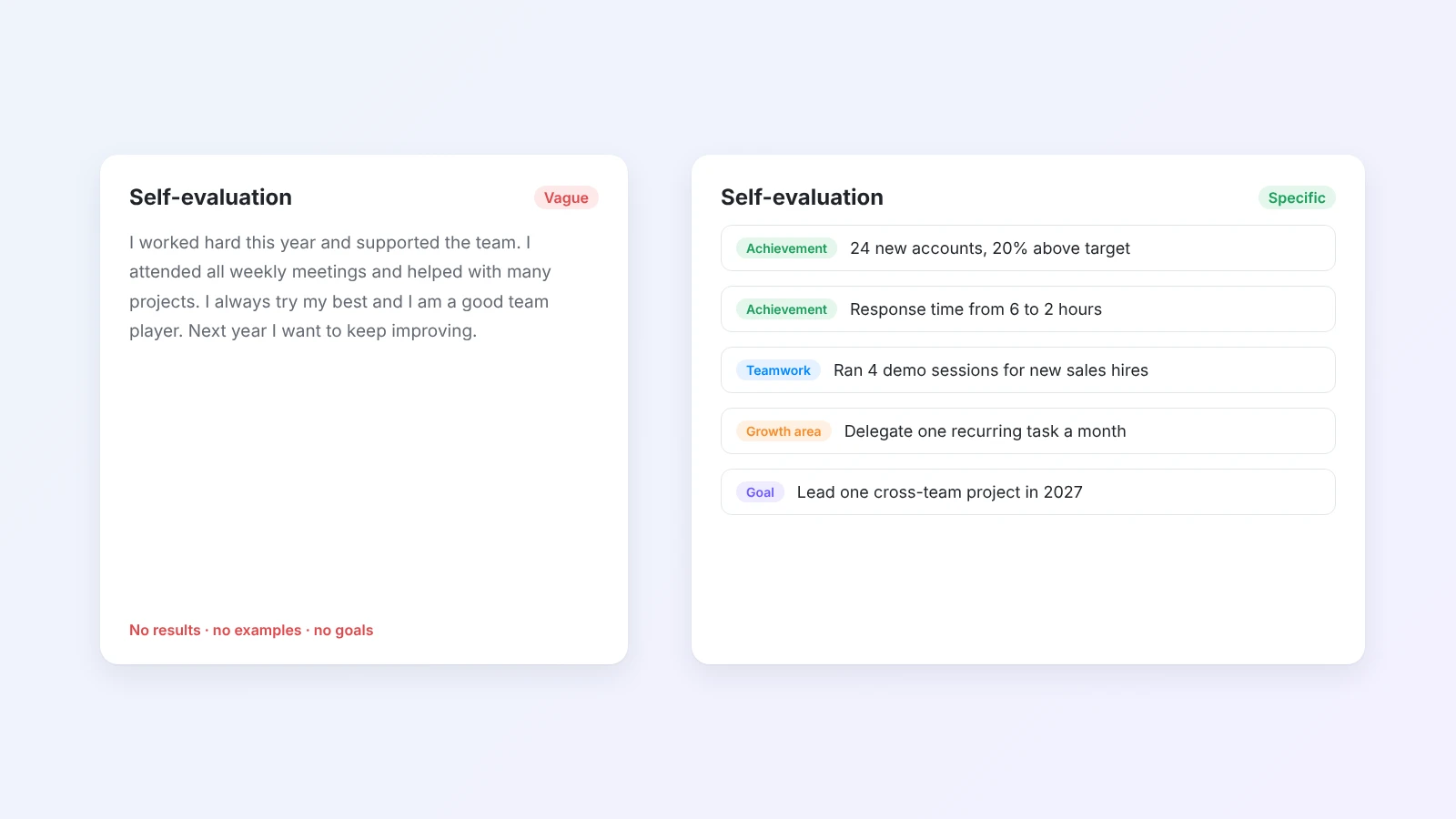
A self-evaluation matters more than it looks. It is often the first thing your manager reads before writing their own review, and it shapes the conversation about ratings, raises, and promotions. A vague one ("I worked hard and supported the team") gives them nothing to use. A specific one gives them your best arguments, ready to repeat.
This guide shows how to write a strong self-evaluation in five steps, with examples you can adapt and a simple system so next year takes minutes instead of an evening.
The short answer
To write a self-evaluation, first gather evidence from the year: projects, results, feedback, and numbers. Then choose three to five key achievements and write each one with the STAR method (situation, task, action, result), ending with the impact. Add how you worked with others, one or two honest growth areas with what you learned, and two or three goals for next year. Keep it to about one page, and check every claim against your notes. If you want a fast first draft, paste your notes into the AI self-evaluation generator and edit the result.
What a self-evaluation is for
A self-evaluation, also called a self-assessment or self-appraisal, is your own written review of your performance over a period, usually a year or half-year. It has three jobs:
- Show impact. What changed because of your work?
- Give context. What made the work hard, and what did you do about it?
- Shape what comes next. Which goals, skills, or roles do you want to grow into?
Your manager may not remember everything you did. The self-evaluation is your chance to make sure the important things are on the table.
How to write a self-evaluation in 5 steps
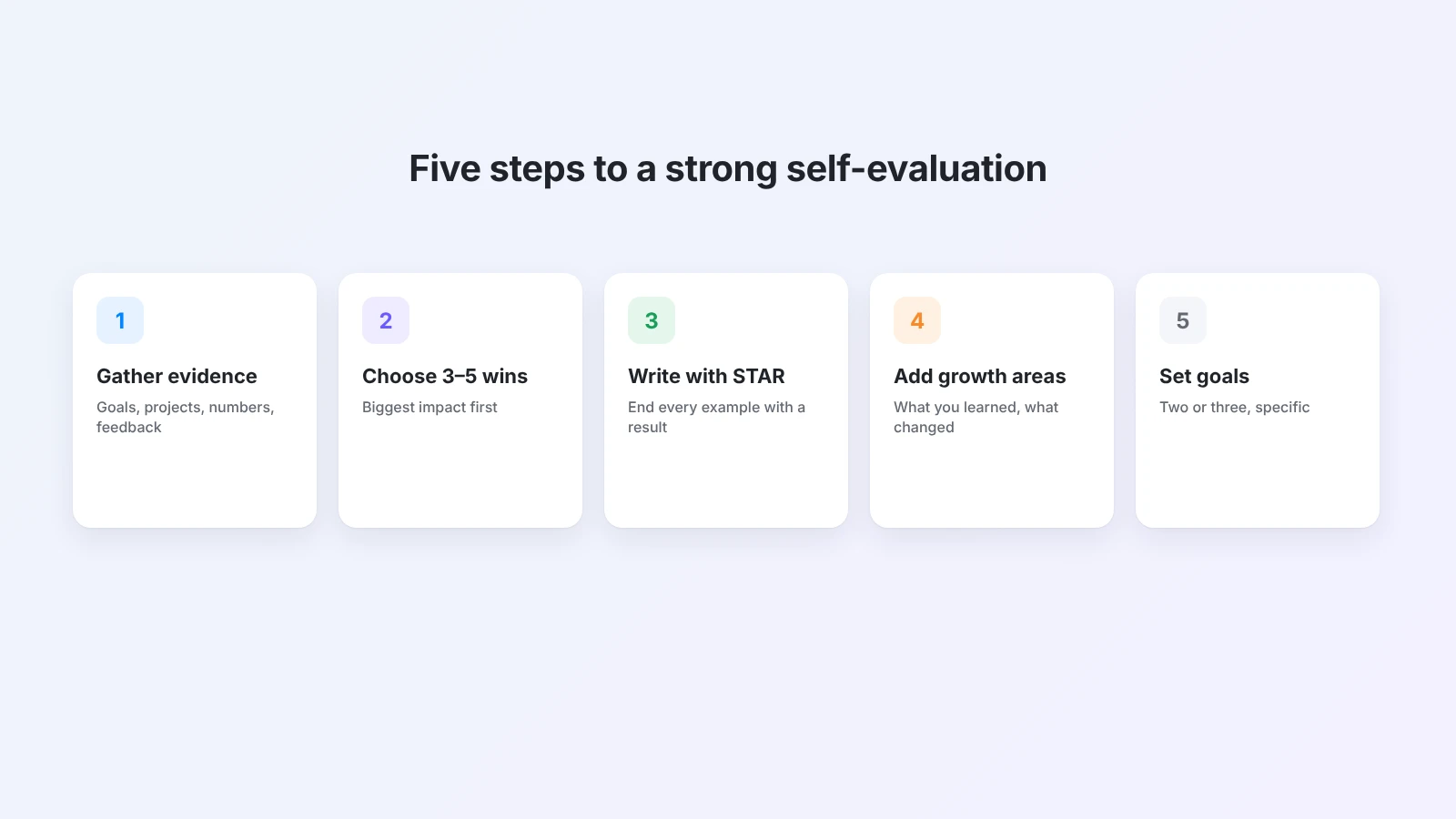
Step 1: Gather evidence before you write
Do not start from memory. Spend 30 minutes collecting:
- Your goals or OKRs for the period, and how far you got
- Projects you led or contributed to, with dates
- Numbers: revenue, time saved, tickets closed, users reached, error rates
- Feedback: thank-you messages, comments from reviews, customer quotes
- Things that went wrong, and what you changed afterwards
Look through your calendar, task list, sent emails, and weekly notes. If you write weekly reports, this step is mostly done.
Step 2: Choose three to five key achievements
You cannot include everything, and you should not try. Pick the work that had the biggest effect on your team, customers, or company, or that shows a skill you want to be known for. Three strong examples beat ten weak ones.
Step 3: Write each achievement with the STAR method
STAR keeps examples short and concrete:
- Situation: the context in one sentence
- Task: what you were responsible for
- Action: what you actually did
- Result: what changed, with a number if possible
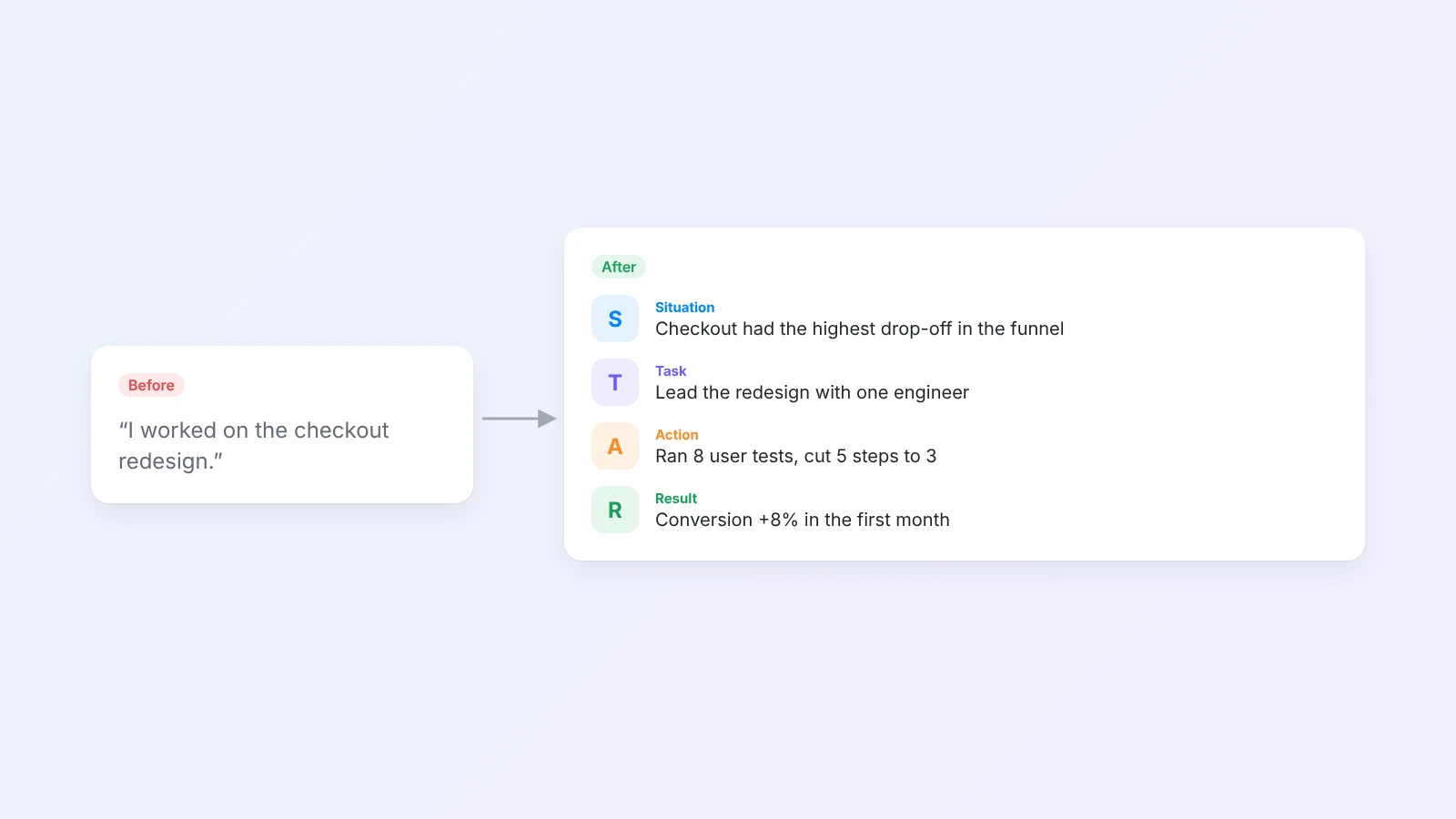
Before: "I worked on the checkout redesign."
After: "Our checkout had the highest drop-off in the funnel (situation). I led the redesign with one engineer (task), ran eight user tests, and cut the flow from five steps to three (action). Conversion rose by 8% in the first month (result)."
If you do not have an exact number, use a clear comparison: "from weekly to daily", "the first time our team…", "reduced back-and-forth with legal to one review".
Step 4: Add honest growth areas
Reviews that mention no weaknesses feel less credible. Choose one or two real areas, and write them as learning:
- What happened, without blaming others
- What you learned
- What you are doing differently now
"I took on too many projects in Q2, and two deadlines slipped. I now agree on priorities with my manager every Monday, and I have not missed a deadline since August."
Step 5: Set goals for next year
End with two or three goals that connect to your growth areas or to where you want to go. Make them specific: "lead one cross-team project", "present our results at the all-hands", "get certified in data analysis". If your company uses OKRs, the AI OKR generator can help turn a goal into measurable key results.
Self-evaluation examples by skill
Adapt these to your own work. Replace the numbers with your own; never use a number you cannot back up.
Results and impact
- "I closed 24 new accounts this year, 20% above my target, including our largest customer in the region."
- "I reduced average ticket response time from 6 hours to 2 by introducing a triage rota."
- "The onboarding emails I rewrote raised week-one activation from 22% to 29%."
- "I delivered all four quarterly releases on schedule, with no critical bugs after launch."
Communication
- "I started a short weekly update for stakeholders, which cut status questions in our channel by about half."
- "I presented our research findings to the leadership team and turned them into three decisions for Q3."
- "I rewrote our product documentation in plain language; support tickets about setup dropped noticeably."
- "I learned to share bad news early, such as the vendor delay in May, which gave us two weeks to plan around it."
Teamwork and collaboration
- "I paired with the design team every week during the redesign, which removed a full review round."
- "I covered the on-call rota for a colleague on leave for three weeks without any missed incidents."
- "I organized our cross-team retrospective and followed up on all six action items."
- "I helped the new sales team learn our product by running four internal demo sessions."
Leadership and mentoring
- "I mentored two junior designers; both now run user interviews on their own."
- "I led a team of five through the platform migration and kept everyone informed with a weekly plan."
- "I introduced a decision log for our project, so new team members can see why choices were made."
- "I stepped in as acting team lead for two months and kept all commitments on track."
Problem-solving
- "When our main supplier failed, I found and onboarded a backup within ten days."
- "I traced a recurring billing error to a timezone bug and wrote the fix and the test."
- "I noticed churn rising among small customers and proposed the check-in calls that reduced it."
- "I simplified our approval process from four sign-offs to two without losing control."
Initiative and innovation
- "I built a small dashboard that saves our team about two hours of manual reporting each week."
- "I proposed and ran the pilot for AI-assisted meeting notes, which the whole department now uses."
- "I started our internal knowledge base and wrote the first 20 pages."
- "I volunteered to own the accessibility audit and fixed the five most serious issues."
Time management and reliability
- "I met every deadline on my three main projects, and flagged risks early on the one that slipped."
- "I planned my work in weekly priorities, which helped me handle twice as many requests as last year."
- "I set up templates for recurring reports, cutting preparation time from a day to two hours."
Growth areas, written constructively
- "I want to delegate more. This year I held on to tasks too long; I am now handing off one recurring task per month."
- "Public speaking is still hard for me. I have joined our internal presentation club and will present twice next half."
- "I sometimes started building before agreeing on scope. I now write a one-page brief before every project."
- "I need to improve my data skills, so I have planned a SQL course for Q1."
Common mistakes to avoid
- Listing tasks instead of results. "Attended weekly meetings" is not an achievement. Say what changed.
- Being too modest. If the result came from your work, say "I" and claim it.
- Being vague. "Improved processes" means nothing without what, how, and how much.
- Blaming others for problems. Describe what happened and what you learned.
- Writing it in one evening. Without evidence, you will forget half the year.
Make next year’s self-evaluation easy
The hardest part of a self-evaluation is remembering. Fix that once, and every future review gets easier:
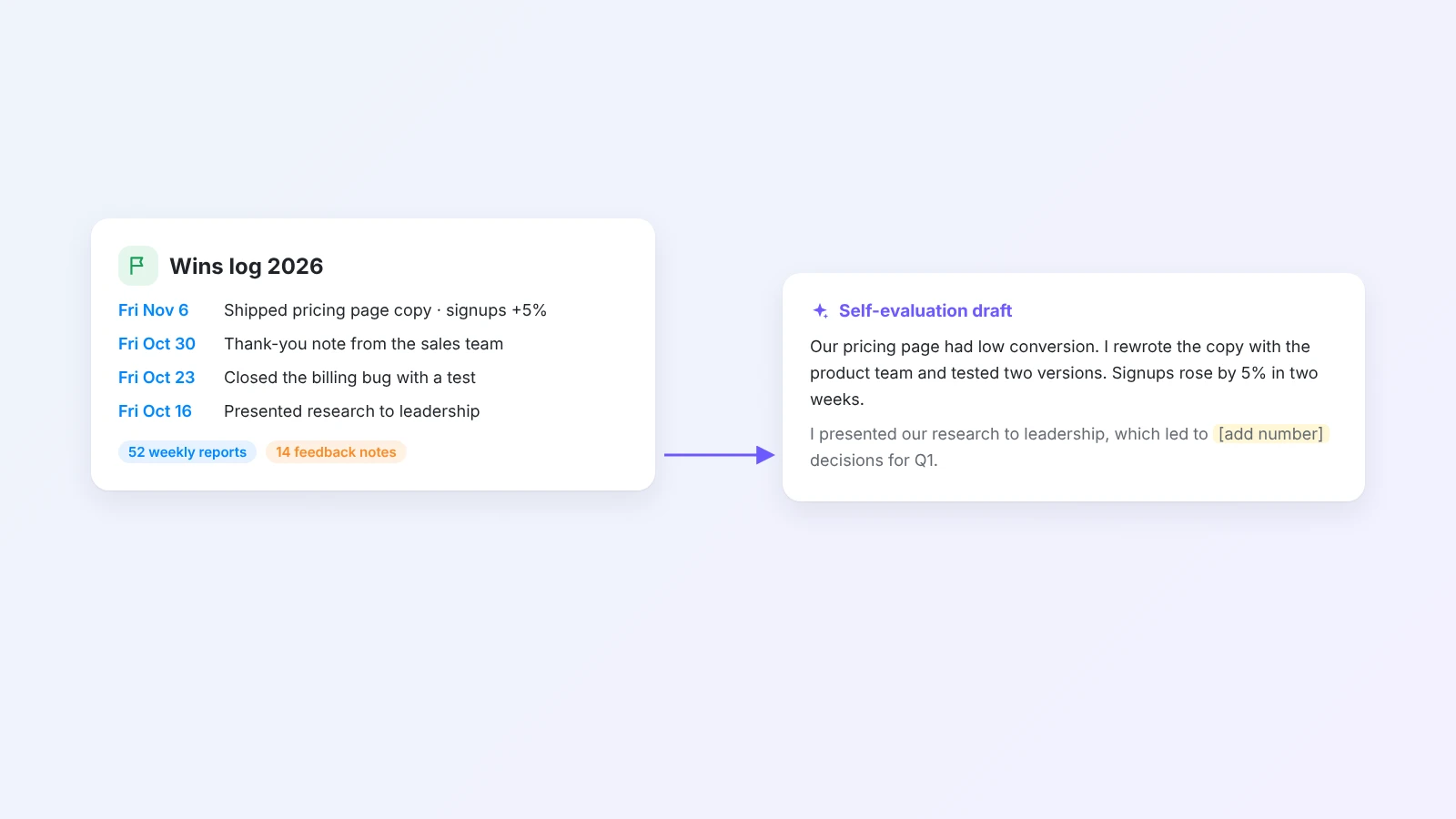
- Keep a "wins" page. Each Friday, add one line: what you shipped, a number, a kind message. Two minutes a week.
- Write short weekly reports. They become a timeline of your year. The AI weekly report generator turns messy notes into one in a minute.
- Save feedback when you get it. Copy praise and useful criticism into the same page.
- Draft with AI, finish yourself. At review time, paste your wins page into the AI self-evaluation generator. It drafts a STAR-structured review from your notes and marks places to add numbers with [add number] instead of inventing them.
In Buildin, you can keep the wins page, weekly reports, and goals in one place, and ask Buildin Agent to summarize the whole year before your review. For setting next year’s goals, see how to set goals for 2027.
Final thoughts
A good self-evaluation is short, specific, and honest. Gather evidence first, choose your strongest achievements, write them with results, own one or two growth areas, and set goals that point where you want to go.
Start this year’s draft with the AI self-evaluation generator, and start next year’s wins page in Buildin for free today.

Amara Elara
Specializes in visualizing complex processes and improving product education. Responsible for user support, product tutorials, and visual guides at Buildin, helping users improve tool adoption and overall productivity.